



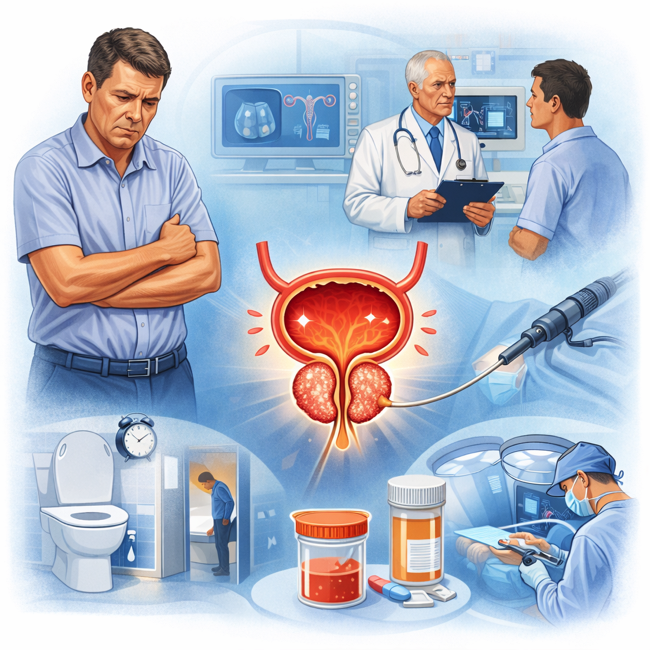
Enlarged Prostate (BPH): Symptoms, Diagnosis, and Treatment Explained
Ask any group of men over 50 whether they have noticed changes in their urinary habits — and if they are being honest, most of them will say yes. Trips to the bathroom that take longer than they used to. Getting up twice in the night. A stream that is not what it once was. These are not random inconveniences of getting older. In most cases, they are the early signs of Benign Prostatic Hyperplasia — more commonly known as an enlarged prostate or BPH.
BPH is one of the most common conditions affecting men as they age. It is not cancer. It is not life-threatening on its own. But left unmanaged, it can significantly affect quality of life — and in some cases, lead to serious urological complications. Understanding what BPH is, what it does to your body, and what modern treatment can offer is the first step toward reclaiming your urological health.
What Is the Prostate and Why Does It Enlarge?
The prostate is a small, walnut-sized gland that sits directly below the bladder and surrounds the urethra — the tube through which urine and semen exit the body. Its primary role is producing a portion of the seminal fluid that nourishes and transports sperm.
The prostate grows in two distinct phases of a man’s life — during puberty, and again typically from around the age of 25 onwards. This second phase of growth is slow and continues throughout life. For many men, this gradual enlargement eventually reaches a point where the prostate begins to squeeze the urethra — and that is when urinary symptoms begin to appear.
The cause of BPH is not fully understood, but hormonal changes — specifically the balance between testosterone and oestrogen, and the role of dihydrotestosterone (DHT) — are believed to drive prostate cell growth over time.
Who Gets BPH?
BPH is extremely common. Studies show that approximately:
- 50% of men in their 50s have some degree of prostatic enlargement
- 70% of men in their 60s are affected
- By the age of 80, the figure rises to over 90%
Not every man with an enlarged prostate will develop troublesome symptoms — but a significant proportion will. And in India, where men are traditionally reluctant to seek medical help for urological complaints, many cases are diagnosed later than they should be.
Symptoms of Enlarged Prostate: What to Look For
BPH symptoms fall into two broad categories — obstructive (caused by the physical blockage of the urethra) and irritative (caused by the secondary effects on the bladder).
Obstructive Symptoms
- Weak or slow urine stream
- Difficulty starting urination (hesitancy)
- Straining or pushing to urinate
- Interrupted or stop-start flow
- Feeling of incomplete bladder emptying
- Dribbling after urination ends
Irritative Symptoms
- Frequent urination — especially needing to go every hour or two
- Urgency — a sudden, strong urge to urinate that is hard to postpone
- Nocturia — waking up two or more times at night to urinate
- Burning or discomfort during urination (less common in BPH alone)
The severity of symptoms is measured using a standardised questionnaire called the International Prostate Symptom Score (IPSS) — a useful tool that helps both patients and doctors quantify how much BPH is affecting daily life and track improvement over time.
Complications of Untreated BPH
This is the part that motivates men to finally act. BPH that is ignored or poorly managed can progress to serious complications:
- Acute urinary retention — A sudden, complete inability to urinate. This is a medical emergency requiring immediate catheterisation.
- Chronic urinary retention — Gradual build-up of urine in the bladder leading to bladder muscle damage and overflow incontinence.
- Recurrent UTIs — Incomplete bladder emptying creates a reservoir for bacterial growth.
- Bladder stones — Concentrated, stagnant urine in the bladder promotes stone formation.
- Kidney damage — In severe, long-standing cases, back-pressure from the blocked bladder can affect kidney function.
None of these complications are inevitable with proper management — but they are real risks in men who delay seeking treatment.
How Is BPH Diagnosed?
Diagnosis of an enlarged prostate involves a combination of clinical assessment and targeted investigations:
- Medical history and IPSS questionnaire — Understanding symptom severity, duration, and impact on daily life.
- Digital Rectal Examination (DRE) — A brief physical examination allowing the urologist to assess prostate size and texture.
- PSA blood test — Elevated PSA can indicate BPH, prostatitis, or prostate cancer. Context matters — a good urologist interprets PSA carefully rather than in isolation.
- Urine flow test (Uroflowmetry) — Measures how fast urine flows and the total volume passed.
- Post-void residual measurement — Ultrasound to check how much urine remains in the bladder after urination.
- Ultrasound of prostate and kidneys — Assesses prostate volume, bladder wall thickening, and any upper urinary tract involvement.
Treatment Options for Enlarged Prostate in Ahmedabad
The good news about BPH is that treatment options are wide-ranging — from simple lifestyle changes to advanced minimally invasive surgery. The right choice depends on symptom severity, prostate size, the presence of complications, and the patient’s overall health.
Watchful Waiting
For men with mild symptoms and no complications, active monitoring with regular reviews is a reasonable starting point. Lifestyle modifications — reducing evening fluid intake, limiting caffeine and alcohol, and double voiding — can make a meaningful difference at this stage.
Medications
Two main classes of medications are used:
- Alpha-blockers (e.g., tamsulosin) — Relax the smooth muscle of the prostate and bladder neck, improving urine flow relatively quickly.
- 5-alpha reductase inhibitors (e.g., finasteride, dutasteride) — Shrink the prostate over 3–6 months by blocking the hormonal driver of prostate growth.
These are often prescribed together for optimal effect in men with moderate-to-large prostates.
Minimally Invasive Surgical Treatments
When medications fail or symptoms are severe, surgery is the most effective and durable solution. Modern BPH surgery is far less invasive than open prostatectomy of decades past:
- Bipolar TURP (Transurethral Resection of the Prostate) — The gold standard surgical treatment for BPH. The enlarged prostate tissue is removed through the urethra using an electrosurgical resectoscope — no external incisions required. Advanced bipolar technology makes this procedure safer, with reduced bleeding risk and faster recovery compared to older monopolar techniques.
- Laser Prostatectomy (HoLEP / GreenLight) — Uses laser energy to ablate or enucleate prostate tissue. Particularly useful for very large prostates and patients on blood thinners.
- UroLift — A minimally invasive procedure that mechanically holds the enlarged prostate lobes apart without removing tissue — suitable for selected patients who want to preserve sexual function.
When Should You Act?
If your urinary symptoms are affecting your sleep, your confidence, your social activities, or your daily comfort — it is time to stop dismissing them as normal and get a proper evaluation. Many men wait years before seeking help, by which point the bladder has often sustained damage that is harder to reverse.
Early diagnosis means simpler treatment. And simpler treatment means faster recovery and better long-term outcomes.
Expert BPH Care in Ahmedabad
Dr. Prarthan Joshi at Zydus Hospitals, Ahmedabad, offers comprehensive evaluation and the full spectrum of treatment options for men with prostate-related urinary symptoms. Whether you need lifestyle guidance, medications, or surgical intervention — you will receive an honest assessment and a personalised treatment plan.
For expert Enlarged Prostate Treatment in Ahmedabad and BPH Treatment in Ahmedabad, consult Dr. Prarthan Joshi today — and get back to sleeping through the night.