



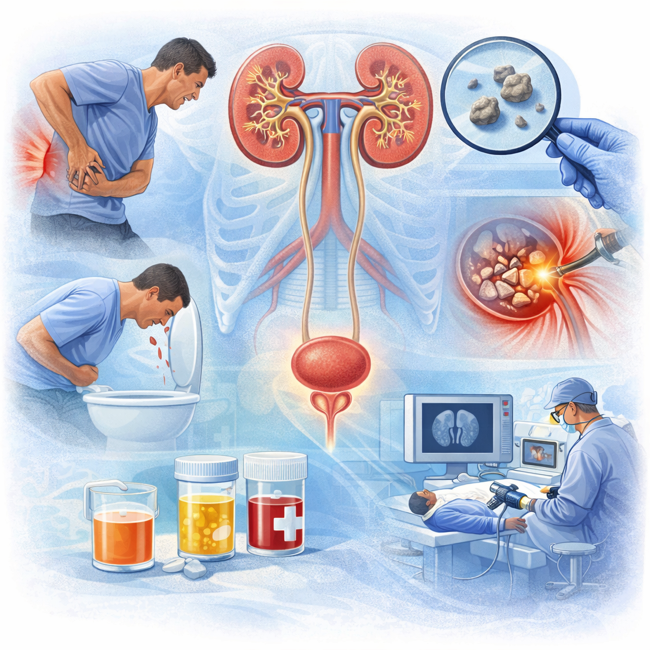
Kidney Stones: Causes, Symptoms, and Modern Treatment Options
If you have ever had a kidney stone, you do not need anyone to describe the pain. It is the kind of pain that has a way of becoming your entire world — sharp, relentless, radiating from your back or side through to your abdomen — and it tends to arrive without warning, often in the middle of the night or at the most inconvenient moments imaginable.
If you have not had one but want to understand what a family member or friend is going through — or whether symptoms you are experiencing might be kidney-stone related — this article covers everything you need to know. From what causes them and how to recognise them, to the modern treatment options that have made kidney stone management dramatically more effective and less invasive than it was even a decade ago.
What Are Kidney Stones?
Kidney stones — medically known as nephrolithiasis or urolithiasis — are hard, crystalline deposits that form inside the kidneys when certain substances in urine become highly concentrated and begin to crystallise. They can range in size from a tiny grain of sand to a large, irregular mass the size of a golf ball. Most stones begin small and either pass on their own or require medical intervention depending on their size, location, and composition.
Kidney stones are one of the most common urological conditions worldwide — and India has one of the highest incidence rates globally, partly due to climatic factors (heat and sweating) and dietary patterns.
Types of Kidney Stones
Not all kidney stones are the same — and knowing the type matters for both treatment and prevention:
- Calcium oxalate stones — The most common type, accounting for roughly 80% of all kidney stones. Formed when calcium combines with oxalate in urine.
- Calcium phosphate stones — Associated with certain metabolic and hormonal conditions, including hyperparathyroidism.
- Uric acid stones — Form in persistently acidic urine. Common in men, those with gout, and patients on high-protein diets.
- Struvite stones — Also called infection stones, these form in association with urinary tract infections caused by specific bacteria that produce ammonia.
- Cystine stones — A rare type caused by a genetic condition (cystinuria) where the kidneys excrete excessive cystine into the urine.
What Causes Kidney Stones?
Kidney stones develop when the balance between stone-forming substances and stone-preventing substances in urine is disrupted. The underlying causes are varied:
Dehydration
The single most modifiable risk factor. When fluid intake is inadequate — especially in hot climates or during physical activity — urine becomes highly concentrated, dramatically increasing the likelihood of crystal formation. In Gujarat’s climate, this is a particularly relevant risk.
Dietary Factors
- High oxalate foods (spinach, nuts, chocolate, tea) increase calcium oxalate stone risk.
- Excessive salt intake raises urinary calcium excretion.
- High animal protein consumption increases uric acid production and lowers urinary pH.
- Low calcium diet — contrary to intuition, adequate dietary calcium actually reduces stone risk by binding oxalate in the gut before it reaches the kidneys.
Medical Conditions
- Hyperparathyroidism — Overactive parathyroid glands raise blood calcium levels, increasing urinary calcium.
- Gout — Elevated uric acid levels predispose to uric acid stone formation.
- Obesity and metabolic syndrome — Associated with insulin resistance and altered urinary pH.
- Inflammatory bowel disease — Conditions like Crohn’s disease increase oxalate absorption from the gut.
- Recurrent UTIs — Particularly with urea-splitting bacteria, predisposing to struvite stones.
Anatomical Factors
Structural abnormalities of the urinary tract — such as horseshoe kidney, ureteropelvic junction (UPJ) obstruction, or medullary sponge kidney — create areas of urinary stasis where stones are more likely to form and accumulate.
Family History
People with a first-degree relative who has had kidney stones are significantly more likely to develop them. Genetic factors influence urinary calcium and oxalate excretion patterns.
Recognising the Symptoms
Kidney stones can be completely silent when they are stationary in the kidney — many people discover them incidentally on imaging done for unrelated reasons. Symptoms typically begin when a stone starts moving from the kidney into the ureter (the tube connecting kidney to bladder):
- Renal colic — The classic presentation. Sudden, severe, cramping pain in the flank (back or side below the ribs) that may radiate to the lower abdomen, groin, or inner thigh. The pain typically comes in waves, intensifying as the ureter spasms around the moving stone.
- Haematuria (blood in urine) — Visible or microscopic blood in urine is extremely common with kidney stones, caused by the stone abrading the ureter lining.
- Nausea and vomiting — Frequently accompany the severe pain, due to shared nerve pathways between the ureter and the gut.
- Frequent or urgent urination — When the stone has moved to the lower ureter near the bladder, it can cause bladder-like urgency and frequency.
- Burning during urination — As the stone approaches the bladder or passes through the urethra.
- Fever and chills — If a stone causes urinary obstruction with associated infection — a urological emergency requiring immediate intervention.
How Are Kidney Stones Diagnosed?
Accurate diagnosis includes imaging to confirm the presence, size, and location of the stone — all of which directly determine the appropriate treatment:
- Non-contrast CT scan (NCCT KUB) — The gold standard for kidney stone diagnosis. Identifies virtually all stone types, sizes, and locations with high accuracy.
- Ultrasound — Useful as an initial investigation, particularly in pregnant patients or children. Less sensitive than CT for small ureteric stones.
- X-ray KUB — Detects calcium-containing stones but misses uric acid stones and small fragments.
- Urine analysis and culture — Checks for blood, infection, and crystal types in urine.
- Blood tests — Kidney function, calcium, uric acid, and phosphate levels.
- Stone composition analysis — If a stone is passed or retrieved, laboratory analysis of its composition guides long-term prevention strategy.
Modern Treatment Options for Kidney Stones
The treatment of kidney stones has been transformed over the past two decades. Open surgery — once the only option for large or complex stones — is now rarely needed. Modern urology offers a range of minimally invasive and non-invasive approaches that are highly effective with minimal patient discomfort and fast recovery.
Conservative Management (Watch and Wait)
Small stones (typically under 5 mm) have a high probability of passing spontaneously with adequate hydration, pain management, and time. Medical expulsive therapy using alpha-blockers (tamsulosin) helps relax the ureteric muscle and speeds up stone passage. Regular monitoring with imaging is needed to ensure the stone is progressing.
ESWL — Extracorporeal Shock Wave Lithotripsy
Shock waves generated outside the body are focused on the stone using ultrasound or X-ray guidance — fragmenting it into smaller pieces that can then pass through the urine naturally. ESWL is non-invasive, performed as a day-care procedure, and is highly effective for selected stones (typically kidney stones under 2 cm in appropriate locations). Multiple sessions may be needed.
URS — Ureteroscopy with Laser Lithotripsy
A thin, flexible or semi-rigid endoscope is passed through the urethra and bladder into the ureter to reach the stone directly. A Holmium laser fibre is then used to break the stone into tiny fragments or dust, which either pass naturally or are retrieved with a basket. URS is the treatment of choice for most ureteric stones and smaller kidney stones, with excellent stone-free rates and quick recovery.
PCNL — Percutaneous Nephrolithotomy
For large kidney stones (over 2 cm), staghorn calculi, or stones in complex locations inaccessible by other means, PCNL is the gold standard. A small puncture is made through the skin directly into the kidney under imaging guidance, and a nephroscope is passed through this tract to directly visualise and remove the stone. Modern miniaturised versions (Mini-PCNL, Micro-PCNL) have significantly reduced the invasiveness and recovery time of this procedure.
Flexible Ureteroscopy (RIRS — Retrograde Intrarenal Surgery)
An advanced technique using a highly flexible digital ureteroscope that can access stones deep within the kidney collecting system — areas that older rigid instruments could not reach. Combined with laser lithotripsy, RIRS offers high stone-free rates for intrarenal stones with a minimally invasive approach and fast post-procedure recovery.
Preventing Kidney Stones from Coming Back
Stone recurrence is common — approximately 50% of people who have had one kidney stone will develop another within 10 years without preventive measures. The good news is that recurrence is highly preventable with the right lifestyle and, where needed, medical interventions:
- Hydrate well — Aim for at least 2.5–3 litres of urine output per day. Clear to light-yellow urine is your target.
- Moderate oxalate intake — Reduce spinach, nuts, and tea if you are prone to calcium oxalate stones.
- Reduce salt — High salt raises urinary calcium.
- Maintain healthy calcium intake — Through food, not supplements, which may increase stone risk.
- Medications — Thiazide diuretics, potassium citrate, allopurinol, or other agents may be prescribed based on your stone type and metabolic evaluation.
Expert Kidney Stone Treatment in Ahmedabad
Dr. Prarthan Joshi at Zydus Hospitals, Ahmedabad, offers the complete range of modern stone management techniques — from ESWL and laser ureteroscopy to PCNL and RIRS — with a strong focus on accurate diagnosis, appropriate treatment selection, and long-term stone prevention planning.
Whether you are in acute pain from a stone, have been told you have stones on imaging but feel no symptoms, or want to prevent further stones after a previous episode — expert help is available. For comprehensive Kidney Stone Treatment in Ahmedabad, consult Dr. Prarthan Joshi at Zydus Hospitals and get a clear, personalised plan for treatment and prevention.