



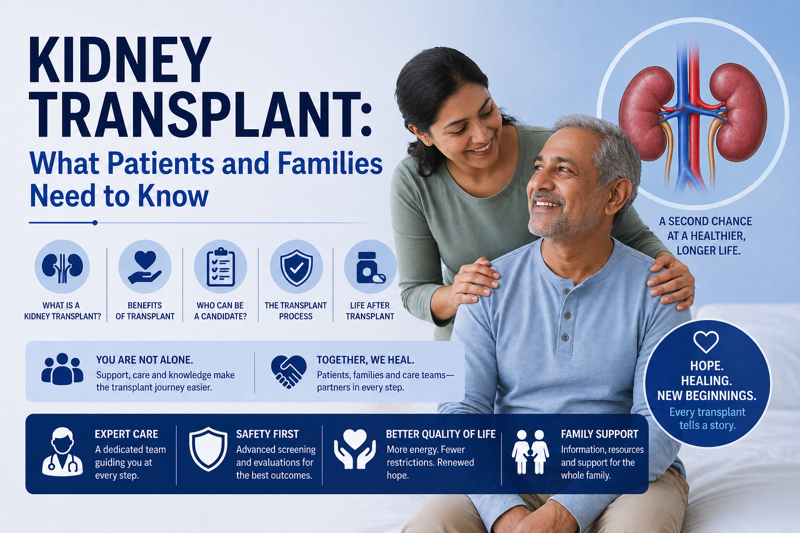
A kidney transplant is not the end of a medical journey — it is the beginning of a better quality of life. For patients living with end-stage kidney disease or severe chronic kidney failure, a successful transplant can mean the difference between a life defined by dialysis and a life defined by freedom, energy, and restored function.
Despite this, kidney transplantation remains widely misunderstood. Many patients arrive at the transplant assessment with fears and misconceptions that have kept them on dialysis far longer than necessary. This article aims to address the most important questions that patients and families have — clearly, honestly, and without unnecessary complexity.
What Is a Kidney Transplant?
A kidney transplant is a surgical procedure in which a healthy donor kidney is placed into a patient whose own kidneys have failed or are functioning at a critically low level. The donated kidney is connected to the patient’s blood vessels and ureter in the lower abdomen, and begins filtering blood and producing urine — restoring kidney function that the patient’s own kidneys can no longer provide.
Importantly, the patient’s own failed kidneys are typically left in place — they are simply bypassed by the new kidney, which does the work. This means the transplanted kidney is placed in addition to, not instead of, the original kidneys.
When Is Kidney Transplant Recommended?
Kidney transplantation is considered when a patient reaches End-Stage Renal Disease (ESRD) — the final stage of chronic kidney disease where kidney function has declined to less than 15% of normal. At this point, the kidneys can no longer adequately filter blood, regulate fluid balance, or remove waste products — making renal replacement therapy (dialysis or transplant) essential to sustain life.
Common conditions leading to kidney failure include:
- Diabetic nephropathy — kidney damage from long-standing poorly controlled diabetes (the most common cause in India)
- Hypertensive nephropathy — kidney damage from chronic high blood pressure
- Glomerulonephritis — immune-mediated kidney inflammation
- Polycystic kidney disease — a genetic condition causing cysts to replace normal kidney tissue
- Obstructive uropathy — long-standing urinary obstruction damaging the kidneys
Transplant vs Dialysis: Why Transplant Offers Better Long-Term Outcomes
Dialysis is a life-sustaining treatment — but it is not a cure. Haemodialysis or peritoneal dialysis replaces only a fraction of normal kidney function and requires patients to commit to sessions several times a week, indefinitely. Quality of life on dialysis is significantly impaired — fatigue, dietary restrictions, fluid limitations, and the time burden of treatment are realities that most dialysis patients live with daily.
A successful kidney transplant, in contrast, restores kidney function to near-normal levels. Studies consistently show that transplant recipients live longer, feel better, and have a significantly higher quality of life compared to those who remain on dialysis. Transplant is not just a treatment preference — for most eligible patients, it is the medically superior option.
Types of Kidney Donation
Living Donor Transplant
A kidney from a living donor — typically a close relative (parent, sibling, spouse, or child) — offers the best outcomes. Living donor kidneys function immediately, have shorter wait times, and have superior long-term survival compared to deceased donor kidneys. The donor undergoes a thorough medical and psychological evaluation to ensure their safety, and lives a completely normal life with one kidney.
Deceased Donor Transplant
A kidney from a brain-dead individual whose family has consented to organ donation. Deceased donor transplant involves waiting on the national transplant registry — wait times vary significantly. Outcomes are excellent but typically not as good as living donor transplants, particularly for older kidneys.
The Transplant Evaluation Process
Before a transplant can proceed, both the recipient and donor undergo extensive evaluation:
- Blood group and tissue typing (HLA matching) to minimise rejection risk
- Crossmatch testing — confirming compatibility between donor and recipient
- Comprehensive medical assessment of the recipient — cardiac, vascular, respiratory, and immunological workup
- Psychological and social assessment of both donor and recipient
- Legal and ethical clearance under the Transplantation of Human Organs Act (THOA)
The Surgery and Immediate Post-Operative Period
Kidney transplant surgery typically takes 3-4 hours. The new kidney is placed in the pelvis, connected to nearby blood vessels, and the ureter attached to the bladder. Most patients notice the new kidney producing urine during or immediately after surgery — a moment that is, for many families, deeply emotional.
Post-operatively, patients are monitored closely in a dedicated transplant unit. Immunosuppressive medications — which prevent the immune system from rejecting the new kidney — are started immediately and must be taken lifelong. Regular follow-up, blood tests, and kidney function monitoring are essential components of long-term transplant success.
Life After Kidney Transplant
Most transplant recipients return to full activity within 4-6 weeks. They can work, travel, exercise, and live essentially normal lives. The dietary and fluid restrictions of dialysis are largely lifted. Energy levels improve dramatically. Many describe transplant as transformative.
Dr. Prarthan Joshi at Zydus Hospitals, Ahmedabad, leads a comprehensive kidney transplant programme offering living and deceased donor transplants with a dedicated multidisciplinary team and state-of-the-art surgical facilities. For expert Kidney Transplant in Ahmedabad, consult Dr. Joshi — and take the first step toward a longer, freer, better life.