



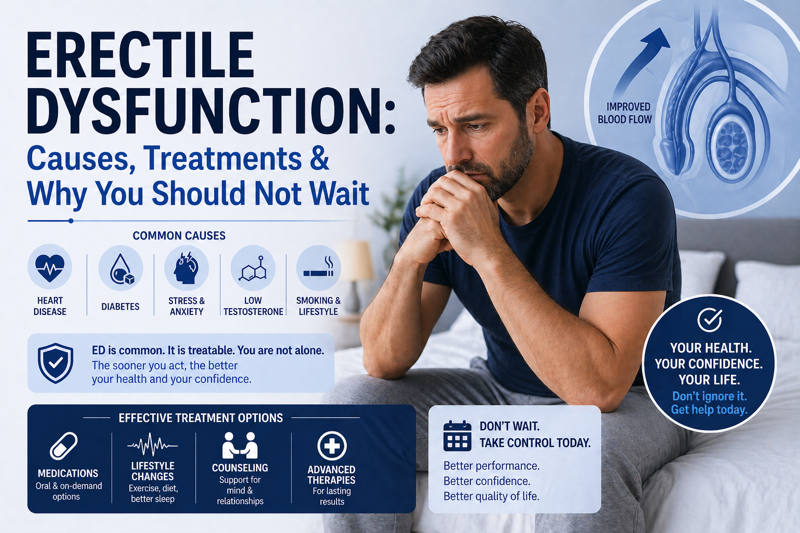
Erectile dysfunction — the persistent inability to achieve or maintain an erection sufficient for satisfactory sexual activity — is one of the most common conditions affecting men worldwide. Studies estimate that ED affects over 150 million men globally, with numbers expected to rise. In India, social stigma and cultural reticence mean that the vast majority of affected men never seek medical help.
This silence is not just unnecessary — it is potentially dangerous. Because ED is not simply a sexual health concern. It is increasingly recognised as an important marker of overall cardiovascular health. In many men, ED is the first clinical sign of underlying vascular disease — appearing years before a heart attack or stroke becomes a risk. Treating ED is not just about restoring sexual function. It is about protecting long-term health.
Understanding How an Erection Works
An erection is a complex neurovascular event. Sexual arousal triggers nerve signals that cause the smooth muscle of the penile arteries to relax — allowing blood to rush into the two chambers of the penis (corpora cavernosa) and produce an erection. Any disruption to the nerve signals, blood flow, hormonal environment, or psychological state that governs this process can result in ED.
Causes of Erectile Dysfunction
ED is rarely caused by a single factor. Most cases involve a combination of physical, hormonal, and psychological contributors:
Vascular Causes — The Most Common
Atherosclerosis (hardening and narrowing of arteries), high blood pressure, high cholesterol, and diabetes all impair blood flow to the penis — the most common physical mechanism of ED. Because the penile arteries are smaller than coronary arteries, vascular disease often manifests as ED before it causes chest pain or a cardiac event. Every man with unexplained ED deserves a cardiovascular risk assessment.
Hormonal Causes
Low testosterone (hypogonadism), elevated prolactin, and thyroid dysfunction can all contribute to reduced libido and erection problems. Hormonal causes are important to identify because they respond well to targeted medical treatment.
Neurological Causes
Conditions affecting nerve signals to the penis — including diabetes-related neuropathy, multiple sclerosis, Parkinson’s disease, spinal cord injury, and nerve damage from pelvic surgery — can all cause or contribute to ED.
Post-Surgical ED
Radical prostatectomy and other pelvic surgeries carry a risk of ED due to proximity to the neurovascular bundles. Modern nerve-sparing robotic surgery has significantly reduced but not eliminated this risk. Post-surgical rehabilitation programmes help maximise recovery of sexual function.
Psychological Causes
Performance anxiety, depression, stress, relationship difficulties, and past negative sexual experiences can cause or significantly worsen ED — even in the absence of physical disease. In younger men, psychological factors are particularly common. Psychosexual counselling is an important part of comprehensive ED management.
Diagnosing Erectile Dysfunction
A proper ED workup is more than asking about sexual symptoms. Comprehensive evaluation includes:
- Detailed sexual and medical history including cardiovascular risk factors
- Hormonal profile: testosterone, LH, FSH, prolactin, thyroid function
- Fasting glucose and lipid profile
- Penile Doppler ultrasound: assessing penile blood flow directly
- Nocturnal penile tumescence testing in selected cases
- Psychological assessment where relevant
Treatment Options for Erectile Dysfunction
Lifestyle Modification
For many men — particularly those with vascular risk factors — addressing the underlying cause is treatment. Stopping smoking, regular aerobic exercise, weight loss, blood pressure and glucose control, and reducing alcohol can produce meaningful improvement in erectile function without any medication.
Oral Medications (PDE5 Inhibitors)
Sildenafil, tadalafil, and vardenafil are the first-line medical treatment for ED. They work by enhancing the natural vasodilatory response to sexual stimulation — they do not produce erections independently. They are effective in approximately 70% of men with organic ED when taken correctly.
Hormone Therapy
Testosterone replacement therapy for men with confirmed hypogonadism can improve both libido and erectile function significantly.
PRP Therapy (Platelet-Rich Plasma)
An emerging, minimally invasive treatment using growth factors from the patient’s own blood to stimulate tissue repair and improve penile vascular health. Suitable for men seeking an alternative or complement to oral medications.
Vacuum Erection Devices and Penile Injections
Effective non-surgical alternatives for men who cannot take or do not respond to oral medications. Intracavernosal injections of vasoactive agents produce reliable erections in most men including those who have failed oral therapy.
Penile Implant Surgery
For men with severe, treatment-resistant ED — particularly those with post-surgical ED, severe vascular disease, or Peyronie’s disease — penile implant surgery offers the most reliable, permanent solution. Modern implants have excellent durability and consistently high patient and partner satisfaction rates.
The Right Time to Act Is Now
ED is not inevitable, and it is not something that simply has to be accepted. It is a treatable medical condition with an increasingly wide range of effective solutions. The longer it is left unaddressed, the more psychological impact it accumulates — and the more the underlying physical cause may progress.
Dr. Prarthan Joshi at Zydus Hospitals, Ahmedabad, offers comprehensive Erectile Dysfunction Treatment in Ahmedabad — from hormonal evaluation and PRP therapy to penile implant surgery — in a completely confidential, professional environment. A consultation is the first step toward real answers and lasting improvement.