



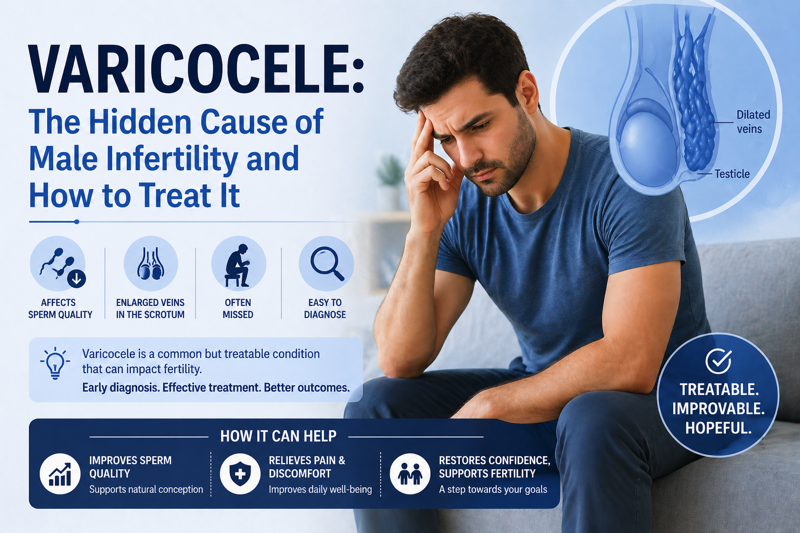
If you are a man who has been told your sperm count, motility, or quality is below normal — or if you have been trying to conceive without success and no obvious cause has been found — there is one condition that deserves to be at the top of your investigation list: varicocele.
Varicocele is the most common correctable cause of male infertility, present in approximately 35-40% of infertile men. It is also frequently missed — because it often causes no symptoms at all, and requires a trained examiner or targeted ultrasound to identify. Yet treating it can make a significant difference to sperm parameters and natural conception rates. Understanding varicocele is, for many couples, the first real step forward in their fertility journey.
What Is a Varicocele?
A varicocele is an abnormal enlargement and tortuosity of the veins that drain blood from the testicle — essentially a cluster of varicose veins in the scrotum. The left side is affected far more commonly than the right (approximately 80-90% of cases) due to the angle at which the left testicular vein drains into the left renal vein.
Normally, blood flows away from the testicle efficiently through these veins. When valves within the veins fail, blood pools and creates elevated pressure and temperature within the scrotal veins — surrounding the testicles in a warmer-than-normal environment. Since healthy sperm production requires a scrotal temperature 2-4 degrees Celsius below core body temperature, this elevated heat significantly impairs spermatogenesis.
How Does Varicocele Cause Infertility?
The mechanism is multifactorial — varicocele damages sperm through several simultaneous pathways:
- Elevated scrotal temperature directly impairs sperm production and DNA integrity.
- Venous stasis reduces oxygen delivery and increases oxidative stress on testicular cells.
- Reflux of adrenal hormones and metabolites from the renal vein into the testicular circulation disrupts hormonal environment.
- Elevated levels of reactive oxygen species (free radicals) damage sperm membranes and DNA.
The cumulative result is reduced sperm count (oligospermia), impaired sperm motility (asthenospermia), and abnormal sperm morphology (teratospermia) — sometimes all three simultaneously, a pattern called oligoasthenoteratospermia (OAT).
Does Varicocele Always Cause Symptoms?
Not always — and this is why it is so frequently missed. Many men with varicocele have no discomfort at all and discover it only during infertility evaluation. Some men experience:
- A dull, aching discomfort or heaviness in the scrotum — often worse after prolonged standing or physical activity and relieved by lying down.
- A visible or palpable cluster of enlarged veins in the scrotum — classically described as feeling like a “bag of worms.”
- Testicular asymmetry — the affected testicle may appear smaller than the other due to impaired development.
The absence of symptoms does not reduce the fertility impact of a significant varicocele. Grades II and III varicoceles — those palpable on clinical examination — have the clearest evidence of fertility impact and benefit from surgical correction.
Diagnosing Varicocele
Clinical diagnosis is made by examination — the urologist feels for enlarged veins in the standing position, often while the patient performs a Valsalva manoeuvre (bearing down) to increase venous pressure and make the veins more prominent.
Scrotal ultrasound with Doppler is the confirmatory investigation — providing objective measurement of vein diameter and demonstrating retrograde (reversed) blood flow on Valsalva, which is the hallmark of clinically significant varicocele. In men being evaluated for infertility, semen analysis and hormonal profiling should always accompany varicocele evaluation.
Treatment: Microsurgical Varicocelectomy
Not every varicocele requires treatment — the decision depends on the grade, the presence of abnormal semen parameters, and the couple’s fertility goals. For men with clinical varicocele, impaired semen parameters, and a desire to achieve conception, surgical correction is strongly recommended.
The gold standard surgical technique is microsurgical varicocelectomy — performed through a small incision below the groin under microscopic magnification. The dilated veins are carefully identified and ligated while preserving the testicular artery, lymphatics, and vas deferens. The microscope is essential — it allows the surgeon to confidently distinguish the tiny testicular artery from surrounding veins, minimising the risk of the most serious complication (testicular atrophy from arterial injury).
Compared to other approaches (laparoscopic or non-microsurgical open), microsurgical varicocelectomy has the highest success rates, lowest recurrence rates, and the lowest complication rates — making it the preferred technique in centres with appropriate expertise.
What Results Can Be Expected?
Sperm parameter improvement is gradual — spermatogenesis takes approximately 72 days, so meaningful improvement in semen analysis is typically seen 3-6 months after surgery. Studies consistently show:
- Improvement in sperm count, motility, and morphology in the majority of men
- Natural conception rates of 30-40% within 12 months of surgery in couples with no other infertility factors
- Improved outcomes in IVF/ICSI cycles when varicocele is corrected before assisted reproduction
Dr. Prarthan Joshi at Zydus Hospitals, Ahmedabad, offers microsurgical varicocelectomy and comprehensive male infertility evaluation. For expert Varicocele – Male Infertility Treatment in Ahmedabad that directly improves your fertility prospects, a consultation is the most valuable step you can take today.