



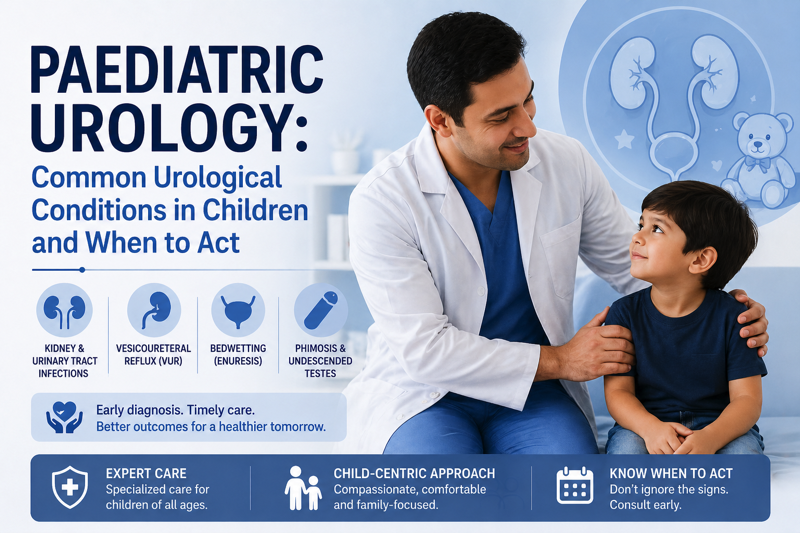
Children can develop a range of urological conditions — some present at birth, others emerge during childhood development. Many parents are surprised to learn that urological problems are among the most common congenital and developmental conditions requiring specialist care in children. Early recognition and timely treatment are crucial — because many paediatric urological conditions, if left unaddressed, can affect kidney function, fertility, and urinary health well into adulthood.
This article covers the most common paediatric urological conditions, their warning signs, and when specialist evaluation by a paediatric urologist is necessary.
Undescended Testis (Cryptorchidism)
The testicles normally descend from the abdomen into the scrotum during the last trimester of pregnancy or within the first few months after birth. When this descent fails to complete, the testicle remains undescended — a condition known as cryptorchidism.
Undescended testis is the most common genital abnormality in boys — present in approximately 3% of full-term male newborns. In premature babies, the incidence is higher. The concern with an undescended testis is significant — an undescended testicle is exposed to higher body temperature than normal, impairing sperm production. If uncorrected, it carries an increased risk of infertility and testicular cancer in adulthood.
Spontaneous descent occurs in most cases within the first 6 months of life. If the testicle has not descended by 6 months of age, surgical correction (orchidopexy) is recommended — ideally between 6 and 18 months — to give the testicle the best chance of normal development and minimise long-term risks.
Hypospadias
Hypospadias is a congenital condition in which the opening of the urethra is located on the underside of the penis rather than at the tip. The degree of displacement varies from mild (near the tip) to severe (towards the base or scrotum). Associated anomalies include a curved penis (chordee) and an abnormal foreskin.
Hypospadias occurs in approximately 1 in 200-300 male births. Surgical correction (urethroplasty) is recommended — typically between 6 and 18 months of age — to restore normal urinary function, correct penile curvature, and ensure normal appearance and sexual function in adulthood. Modern surgical techniques achieve excellent results when performed by an experienced paediatric urologist.
Vesicoureteral Reflux (VUR)
Vesicoureteral reflux is the abnormal backward flow of urine from the bladder up into the ureters and kidneys. Normally, the junction between the ureter and bladder acts as a one-way valve. When this mechanism is defective — either due to a congenital abnormality or as a consequence of bladder dysfunction — urine refluxes upward, carrying bacteria toward the kidneys and causing recurrent febrile urinary tract infections.
VUR is an important cause of recurrent UTIs in children — particularly young girls. More critically, repeated kidney infections (pyelonephritis) can cause renal scarring that impairs long-term kidney function. Diagnosis is confirmed with a voiding cystourethrogram (VCUG). Management ranges from low-dose prophylactic antibiotics and close monitoring (for lower grades) to endoscopic or surgical correction (for higher grades or breakthrough infections).
Pelviureteric Junction (PUJ) Obstruction
PUJ obstruction is a blockage at the junction where the renal pelvis meets the ureter, impeding drainage of urine from the kidney. It is the most common cause of hydronephrosis (a dilated, fluid-filled kidney) in children. Many cases are now detected antenatally on routine ultrasound.
Mild PUJ obstruction in infants may be monitored conservatively with serial ultrasounds and nuclear kidney function tests. Significant obstruction with impaired kidney function or recurrent infections requires pyeloplasty — a reconstructive operation that removes the obstructed segment and creates a wide, freely draining connection. Minimally invasive (laparoscopic or robotic) pyeloplasty has become the preferred approach in experienced centres, offering excellent outcomes with faster recovery.
Recurrent Urinary Tract Infections in Children
UTIs are common in children — particularly girls — but recurrent UTIs are never normal and always warrant investigation to exclude an underlying anatomical or functional cause. Key red flags include:
- Febrile UTI (infection associated with high fever) in any child under 5 — warrants imaging to exclude VUR or structural abnormality.
- UTI in any male child at any age — always warrants investigation.
- Recurrent UTIs — two or more in girls, one in boys.
Investigations include renal ultrasound, VCUG, and DMSA nuclear scan to assess kidney function and detect scarring. Early identification and treatment of underlying causes prevents progressive kidney damage.
Nocturnal Enuresis (Bedwetting)
Bedwetting is developmentally normal in young children but becomes a clinical concern when it persists beyond 5 years of age. Primary nocturnal enuresis (never consistently dry at night) is far more common than secondary enuresis (returning after a period of dryness). Contributing factors include delayed bladder maturation, deep sleep patterns, reduced nocturnal antidiuretic hormone production, and constipation.
Management is structured — starting with addressing constipation, fluid timing, and bladder training. Enuresis alarms are first-line treatment for children above 7. Medication (desmopressin) is effective for selected situations. Most children achieve dryness with appropriate management — the key is not dismissing it as something the child will “grow out of” without seeking guidance.
When to See a Paediatric Urologist
Parents should seek specialist paediatric urological evaluation when their child has any of the following:
- Undescended testicle at or after 6 months of age
- Abnormal urethral opening (hypospadias)
- Recurrent urinary tract infections
- Antenatally detected hydronephrosis
- Persistent bedwetting after age 5-6
- Difficulty passing urine or abnormal urine stream
- Scrotal swelling or pain
Dr. Prarthan Joshi at Zydus Hospitals, Ahmedabad, offers comprehensive paediatric urological care — from newborn evaluation to adolescent urological surgery. For expert Paediatric Urology Treatment in Ahmedabad, early evaluation protects your child’s kidney health and urological future. Do not wait.