



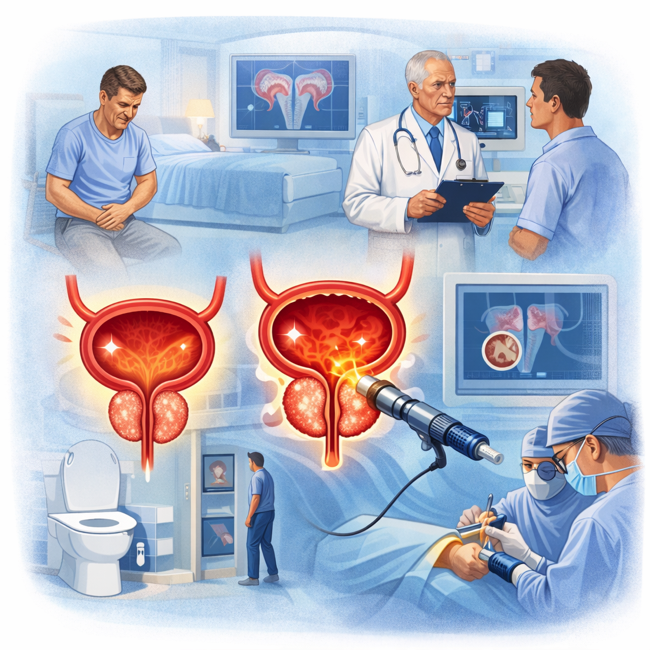
Advanced Bipolar TURP Surgery for Enlarged Prostate Explained
When medications for an enlarged prostate stop working — or when symptoms have progressed beyond what tablets can reasonably manage — surgery becomes the most effective path forward. For decades, the procedure of choice has been Transurethral Resection of the Prostate, better known as TURP. And while the name might sound daunting, what it actually represents is one of the most refined, well-studied, and effective procedures in all of urology.
Today, with the evolution of bipolar energy technology, TURP has become significantly safer, more precise, and better tolerated than it was even ten years ago. If you or someone in your family is facing surgery for an enlarged prostate, understanding what Bipolar TURP involves — and why it is considered the gold standard for BPH surgery — will help you make an informed and confident decision.
First, a Quick Recap: What Is BPH?
Benign Prostatic Hyperplasia (BPH) is the non-cancerous enlargement of the prostate gland that affects a large proportion of men over 50. As the prostate grows, it squeezes the urethra — the tube running through its centre — causing obstructive urinary symptoms like weak stream, hesitancy, incomplete bladder emptying, and irritative symptoms like urgency and nocturia.
When lifestyle changes and medications fail to provide adequate relief, or when complications like urinary retention, bladder stones, or recurrent infections develop, surgical intervention becomes necessary. TURP has been the surgical benchmark for BPH treatment for over 50 years — and bipolar technology has taken it to a new level of safety and efficacy.
What Is Bipolar TURP and How Does It Work?
Transurethral Resection of the Prostate (TURP) is a minimally invasive endoscopic surgery. There are no external incisions — the entire procedure is performed through the urethra. The surgeon passes a thin telescopic instrument called a resectoscope through the urethra to reach the prostate, and then uses an electrified wire loop to systematically remove the obstructing prostate tissue — reopening the urethral channel and restoring normal urine flow.
The key distinction between Bipolar TURP and the older Monopolar TURP lies in how the electrical energy is delivered and how the surgical irrigating fluid is managed:
Monopolar TURP — The Old Standard
In monopolar TURP, electrical current passes from the resectoscope through the patient’s body to a grounding pad on the skin. This required using a non-conducting, hypotonic irrigation fluid (glycine solution) to prevent the saline from dispersing the current. If too much of this fluid absorbed into the bloodstream during surgery, it could cause a serious condition called TURP Syndrome — characterised by fluid overload, dangerously low sodium levels, visual disturbances, and cardiovascular complications. This was a genuine surgical risk, particularly in longer procedures.
Bipolar TURP — The Modern Advancement
In bipolar TURP, both the active and return electrodes are contained within the resectoscope itself. The electrical circuit is completed locally — between the two electrodes at the tip of the instrument — rather than through the patient’s body. This means normal saline can be used as the irrigating fluid instead of glycine. Since saline is isotonic and physiologically compatible with blood, the risk of TURP Syndrome is essentially eliminated.
This single advancement has transformed the safety profile of TURP surgery — particularly for elderly patients, those with cardiac conditions, and those with larger prostates where operating time may be longer.
Key Advantages of Bipolar TURP Over Monopolar TURP
- No TURP Syndrome risk — Normal saline irrigation eliminates the risk of dangerous fluid and electrolyte imbalance.
- Reduced blood loss — Bipolar energy provides superior haemostasis (bleeding control), reducing intraoperative blood loss.
- Safer for complex patients — Patients on anticoagulant medications, those with heart conditions, or those with very large prostates can undergo bipolar TURP with a significantly improved safety profile.
- Shorter catheterisation time — Better haemostasis means the urinary catheter can often be removed sooner after surgery.
- Faster recovery — Reduced blood loss and fluid complications translate directly into shorter hospital stays and quicker return to normal activities.
- Comparable tissue removal quality — Bipolar resection achieves the same extent and quality of prostate tissue removal as monopolar, without the associated risks.
Who Is Bipolar TURP Recommended For?
Bipolar TURP is the recommended surgical treatment for BPH in men whose symptoms cannot be adequately controlled with medications, and who fall within the appropriate prostate size range (typically 30–80 mL, although larger prostates may be managed with extended bipolar TURP or laser alternatives). It is particularly well-suited for:
- Men who have experienced acute or chronic urinary retention
- Men with recurrent urinary tract infections secondary to incomplete bladder emptying
- Men who have developed bladder stones as a consequence of BPH obstruction
- Older patients or those with cardiovascular conditions who benefit from the improved safety profile of bipolar technology
- Men who have been on BPH medications for extended periods without satisfactory symptom control
What Happens Before, During, and After Bipolar TURP?
Before Surgery
A thorough pre-operative assessment is conducted — including uroflowmetry, post-void residual measurement, prostate ultrasound, urine culture, blood tests, and cardiac evaluation where appropriate. Any active urinary infection must be cleared before surgery. Patients on blood thinners are advised about safe cessation timelines in coordination with their prescribing physician.
During Surgery
Bipolar TURP is performed under spinal or general anaesthesia and typically takes 45–90 minutes depending on prostate size. The patient lies in a lithotomy position (legs elevated and supported). The resectoscope is introduced through the urethra — no skin incisions are made. The obstructing prostate tissue is systematically resected in chips, which are irrigated out of the bladder. Once haemostasis is secured, a three-way urinary catheter is placed to allow continuous bladder irrigation in the immediate post-operative period.
After Surgery
Most patients stay in hospital for 1–2 days post-operatively. The continuous bladder irrigation is typically discontinued within 24 hours once the irrigating fluid runs clear. The urinary catheter is usually removed on day 1 or 2, at which point most patients can urinate comfortably with improved flow. Some temporary burning, urgency, or occasional blood in urine in the first 2–4 weeks is normal and expected. Full recovery and maximum urinary improvement are typically achieved within 6–8 weeks.
What Results Can Patients Expect?
Bipolar TURP delivers durable, significant improvement in urinary symptoms for the vast majority of patients:
- Symptom improvement: 85–90% of patients experience significant reduction in IPSS scores after surgery.
- Improved urine flow: Maximum urine flow rate (Qmax) typically doubles or more after successful TURP.
- Long-term durability: Results are sustained in most patients for 10–15 years. A small proportion may require repeat treatment as the remaining prostate continues to grow over time.
Are There Any Risks?
No surgery is without some degree of risk, and patients deserve honest information. The most common side effects of TURP include:
- Retrograde ejaculation — The most common long-term effect, occurring in 65–75% of men. Semen travels backward into the bladder during orgasm rather than exiting externally. This does not affect sexual pleasure but does affect fertility. Patients planning to father children should discuss this with their surgeon before proceeding.
- Temporary urinary symptoms — Burning, urgency, and occasional blood in urine in the weeks after surgery, which resolve as healing progresses.
- Urinary tract infection — Mitigated with peri-operative antibiotics.
- Urethral stricture (rare) — Scarring of the urethra can occasionally develop over time, requiring treatment.
Erectile dysfunction following TURP is uncommon when the procedure is performed correctly — bipolar technology, with its more controlled energy delivery, has a favourable profile in this regard compared to older techniques.
Bipolar TURP vs. Laser Prostatectomy — Which Is Better?
This is a question that comes up frequently in surgical consultations. The honest answer is: both are excellent procedures — and the right choice depends on the individual patient.
Bipolar TURP remains the most widely validated and cost-effective surgical treatment for BPH in the 30–80 mL prostate range. Laser techniques like HoLEP (Holmium Laser Enucleation of the Prostate) are preferred for very large prostates (over 80–100 mL) and for patients with bleeding disorders or those who cannot safely stop anticoagulant medications. An experienced urologist will recommend the most appropriate procedure based on prostate size, patient health, and institutional expertise.
Expert Enlarged Prostate Surgery in Ahmedabad
Dr. Prarthan Joshi at Zydus Hospitals, Ahmedabad, performs advanced Bipolar TURP and the full range of surgical BPH treatments — bringing clinical expertise, modern technology, and transparent patient communication to every case.
If you have been managing prostate symptoms for years on medication and are wondering whether it is time to consider surgery, a consultation with Dr. Joshi will give you the honest clinical picture and the personalised recommendation you need. For comprehensive BPH Treatment in Ahmedabad and expert Enlarged Prostate Treatment in Ahmedabad, Zydus Hospitals is where advanced surgical care meets genuine patient-centred medicine.