



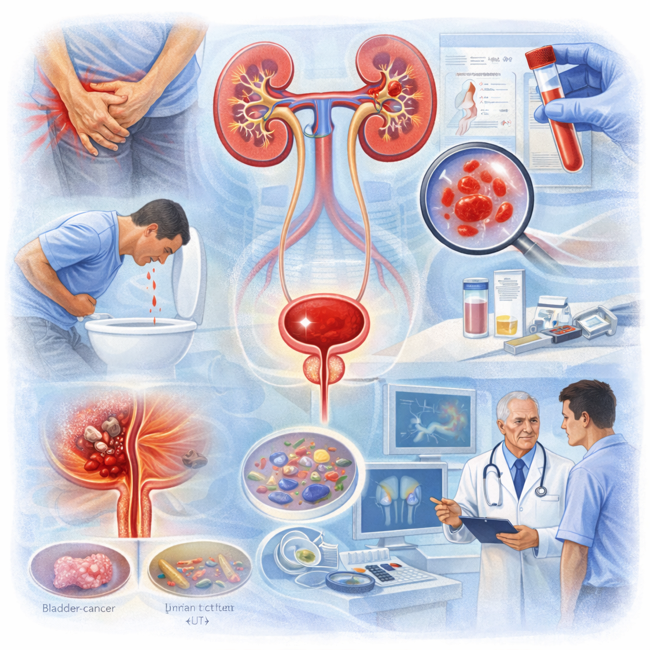
Blood in Urine (Hematuria): When to Worry and When to Act
Seeing blood in your urine is one of those moments that stops you cold. Whether it is a faint pink tinge, a darker red colouration, or something unmistakably alarming — the sight of blood where it is not supposed to be triggers an immediate and entirely justified sense of concern. And rightly so. Blood in urine — medically called haematuria — is never something to dismiss, rationalise away, or wait and see about.
That said, haematuria does not always mean something serious. Its causes range from relatively benign and easily treated — like a urinary tract infection or kidney stone — to conditions that require urgent investigation, including urological cancers. The only way to know which category you are dealing with is proper evaluation by a qualified urologist. No amount of online research changes that fundamental fact.
This article explains what haematuria is, what causes it, how it is investigated, and what modern treatment options look like — so that if you or someone you care about encounters this symptom, you are equipped to act promptly and appropriately.
What Is Haematuria?
Haematuria simply means the presence of red blood cells in the urine. It comes in two forms:
- Gross (visible) haematuria — Blood present in sufficient quantity to visibly discolour the urine pink, red, or brown. This is what most people think of when they imagine blood in urine, and it is the form most likely to prompt immediate medical attention — as it should.
- Microscopic haematuria — Blood present in the urine in quantities too small to be seen with the naked eye, detected only on urine analysis under a microscope (typically defined as ≥3 red blood cells per high power field on two separate clean-catch samples). This is often discovered incidentally during a routine health check — and it deserves the same clinical attention as visible haematuria.
It is also worth distinguishing true haematuria from conditions that can make urine appear red without actually containing blood — including certain foods (beetroot, blackberries), medications (rifampicin), and myoglobinuria following severe muscle injury. A urine dipstick and microscopy quickly clarify this distinction.
How Common Is Blood in Urine?
More common than many people realise. Studies suggest that microscopic haematuria is found in approximately 2–13% of adults on routine urinalysis. Visible haematuria is less common but far more alarming to patients. What both forms share is the need for proper evaluation — because while the majority of haematuria cases have benign causes, a meaningful proportion reveal significant underlying pathology that benefits enormously from early detection.
Causes of Haematuria: From Common to Critical
The urinary tract is a long, complex system — and haematuria can originate from any point within it, from the kidneys down to the urethra. Understanding the range of possible causes helps explain why a thorough workup is necessary rather than assuming the simplest explanation.
Urinary Tract Infections (UTIs)
One of the most common causes of haematuria — particularly in women. Bacterial infection inflames the bladder lining and can cause both microscopic and visible bleeding, usually accompanied by burning during urination, urgency, and frequency. Haematuria typically resolves promptly with appropriate antibiotic treatment. However, UTI should not be used as a convenient explanation for haematuria in men or in women over 40 without further investigation — as other causes must be excluded.
Kidney Stones
As a stone moves through the ureter, its rough surface abrades the delicate lining — causing bleeding that ranges from microscopic to visibly bloody urine, often accompanied by the characteristic severe flank pain of renal colic. Smaller stones may cause only haematuria without significant pain.
Benign Prostatic Hyperplasia (BPH)
An enlarged prostate can cause bleeding from the enlarged, highly vascularised prostate tissue — particularly in men with significant urinary symptoms. This is a diagnosis of exclusion — prostate cancer must be ruled out before BPH is accepted as the cause of haematuria in any man.
Kidney (Renal) Disease
Glomerulonephritis — inflammation of the kidney’s filtering units — is an important medical (rather than surgical) cause of haematuria, typically presenting with microscopic haematuria, protein in the urine, and sometimes elevated blood pressure or reduced kidney function. This is a nephrological rather than urological diagnosis and requires appropriate specialist referral.
Bladder Cancer
This is the cause that makes every urologist take haematuria seriously regardless of how mild it appears. Painless, visible haematuria is the most common presenting symptom of bladder cancer — occurring in over 80% of cases. Bladder cancer can present with a single episode of haematuria that then resolves spontaneously — which is precisely why patients and doctors alike must resist the temptation to reassure themselves that “it stopped, so it must be fine.” It is not fine until it is investigated.
Kidney (Renal) Cancer
Renal cell carcinoma frequently presents with haematuria — often painless and intermittent. The classic triad of flank pain, palpable mass, and haematuria is now uncommon in practice as most renal cancers are detected earlier. Any unexplained haematuria, particularly in combination with flank discomfort or systemic symptoms, warrants renal imaging.
Prostate Cancer
While haematuria is not the most common presenting symptom of prostate cancer, it can occur — particularly in locally advanced disease. PSA testing and prostate evaluation should always be part of the haematuria workup in men.
Ureteral or Renal Pelvis Tumours
Upper tract urothelial carcinomas — tumours of the renal pelvis or ureter — are less common than bladder cancer but equally serious. They characteristically present with haematuria and require dedicated upper tract imaging for diagnosis.
Other Causes
- Trauma to the kidney, bladder, or urethra
- Anticoagulant medications (warfarin, newer oral anticoagulants) — these do not cause haematuria directly but can unmask underlying pathology
- Strenuous exercise (exercise-induced haematuria) — usually benign and self-limiting, but requires at least one proper evaluation to exclude underlying cause
- Endometriosis involving the bladder (cyclical haematuria in women)
- Radiation cystitis — bladder inflammation following pelvic radiotherapy
When Should You See a Doctor?
The answer is simple: always, and promptly.
There is no “safe” amount of blood in urine and no acceptable number of episodes to wait through before seeking evaluation. Even a single episode of painless visible haematuria — even if it resolves completely — deserves full urological investigation. The absence of pain does not make haematuria less serious. In fact, painless haematuria is the more concerning variety because it is more commonly associated with urological malignancy.
Microscopic haematuria found on routine testing also deserves proper follow-up — particularly in adults over 35, smokers, and those with a history of occupational chemical exposure (dyes, rubber, leather industries) — all of which are risk factors for bladder cancer.
How Is Haematuria Investigated?
A thorough haematuria workup covers the entire urinary tract:
- Urine analysis and cytology — Microscopy to confirm red blood cells, culture to rule out infection, and cytology to look for cancer cells in the urine.
- Blood tests — Kidney function, full blood count, clotting profile, PSA in men.
- Imaging — CT urogram (CTU) is the gold standard — a dedicated CT scan that images the kidneys, ureters, and bladder in detail, identifying stones, tumours, structural abnormalities, and renal pathology with high accuracy.
- Flexible cystoscopy — Direct endoscopic examination of the bladder interior using a thin flexible camera passed through the urethra. This is an essential part of haematuria investigation in adults and allows direct visualisation of the bladder lining for any abnormality, tumour, or source of bleeding.
- Renal ultrasound — Useful as an adjunct, particularly for assessing kidney structure and detecting hydronephrosis.
Treatment: It Depends on the Cause
Because haematuria is a symptom rather than a diagnosis, treatment is directed at the underlying cause once it is identified:
- UTI — Targeted antibiotics based on culture results.
- Kidney stones — ESWL, ureteroscopy with laser lithotripsy, or PCNL depending on stone size and location.
- BPH — Medical management or TURP depending on severity.
- Bladder cancer — Transurethral resection of bladder tumour (TURBT) for diagnosis and treatment of superficial tumours, with further management (intravesical therapy, radical cystectomy, or radiotherapy) for higher-risk or invasive disease.
- Renal tumours — Surgical management including nephron-sparing surgery or radical nephrectomy depending on tumour characteristics.
- Glomerulonephritis — Medical management in collaboration with a nephrologist.
The One Thing You Must Not Do
Do not wait. Do not tell yourself it was a one-off. Do not assume it was something you ate or that it is stress-related. Do not ask a pharmacist for something to manage it without a proper diagnosis. Blood in urine always deserves prompt, proper medical evaluation — full stop.
The conditions that haematuria can signal — particularly bladder and kidney cancers — respond dramatically better to treatment when caught early. The investigations needed to rule them out are straightforward, minimally invasive, and widely available. There is no justification for delay.
Expert Haematuria Evaluation and Treatment in Ahmedabad
Dr. Prarthan Joshi at Zydus Hospitals, Ahmedabad, offers a comprehensive, structured haematuria investigation pathway — from CT urogram and urine cytology to flexible cystoscopy and full urological assessment. Every patient is evaluated thoroughly and promptly, with a clear explanation of findings and a personalised management plan.
If you have noticed blood in your urine — even once, even faintly — please do not wait. For expert Hematuria Treatment in Ahmedabad, consult Dr. Prarthan Joshi at Zydus Hospitals today. Early evaluation is the single most important thing you can do for your urological health.