



Circumcision for Diabetic Patients: Benefits, Safety, and Recovery
Diabetes touches nearly every system in the human body — and the urological and genital health of men is no exception. One of the less-discussed but genuinely significant challenges that diabetic men face is the recurring cycle of foreskin infections, inflammation, and tightening that can develop over years of living with poorly controlled or long-standing diabetes.
For many diabetic men, the question eventually becomes not whether to consider circumcision — but whether it is safe for someone with their condition. The answer, delivered clearly and honestly, is yes — circumcision for diabetic patients is safe and highly effective when performed by an experienced urologist who follows a carefully structured protocol designed specifically for high-risk patients.
This article explains why diabetes makes men particularly vulnerable to foreskin problems, what the specific benefits of circumcision are in this population, and what makes the surgical approach different for diabetic patients.
Why Diabetes and Foreskin Problems Go Hand in Hand
To understand why diabetic men are more prone to foreskin complications, you need to understand what elevated blood sugar actually does to the body at a local level — particularly in the genital area.
High Glucose Fuels Infections
Bacteria and fungi thrive in glucose-rich environments. In diabetic men, elevated blood sugar is present not just in the blood but in skin secretions, urine, and the moisture that naturally accumulates beneath the foreskin. This creates precisely the warm, nutrient-rich environment that Candida (thrush) and other pathogens need to establish recurring infections. Standard antifungal or antibiotic treatment provides temporary relief — but as long as elevated blood sugar persists, reinfection is almost inevitable.
Reduced Immune Defence
Diabetes impairs the function of white blood cells — the body’s primary defence against infection. This means that even a small bacterial or fungal colonisation under the foreskin, which a non-diabetic immune system would handle without trouble, can establish itself as a persistent, recurring infection in a diabetic patient.
Peripheral Neuropathy — The Silent Risk
One of the most dangerous aspects of foreskin infections in diabetic men is that peripheral neuropathy — reduced sensation in the extremities caused by nerve damage from long-standing diabetes — means that pain and discomfort may be minimal or absent even when infection is progressing. Men may not notice significant symptoms until the infection or inflammation is already well established, making early intervention more difficult.
Diabetic Phimosis
Repeated cycles of infection and inflammation cause progressive scarring and fibrosis of the foreskin tissue — eventually leading to diabetic phimosis, where the foreskin becomes tight, thickened, and impossible to retract. At this stage, medication alone cannot reverse the structural change. Circumcision becomes the definitive and most appropriate solution.
Medical Conditions That Make Circumcision Necessary for Diabetic Men
The following foreskin-related conditions are significantly more common in diabetic men — and in many of these cases, circumcision is not just beneficial but medically necessary:
- Recurrent balanitis — Recurring inflammation of the glans and foreskin, usually fungal in origin, that keeps returning despite treatment.
- Diabetic phimosis — Progressive tightening and scarring of the foreskin due to chronic inflammation and fibrosis.
- Balanoposthitis — Simultaneous infection of both the glans and the foreskin — painful, persistent, and often resistant to topical treatment alone.
- Paraphimosis — A urological emergency where a retracted, swollen foreskin cannot return to its normal position, cutting off blood supply to the glans. Diabetic men with any degree of foreskin tightening are at higher risk of this complication.
- Hygiene difficulties — Painful or tight foreskin making adequate cleaning impossible — perpetuating the infection cycle.
The Benefits of Circumcision for Diabetic Men
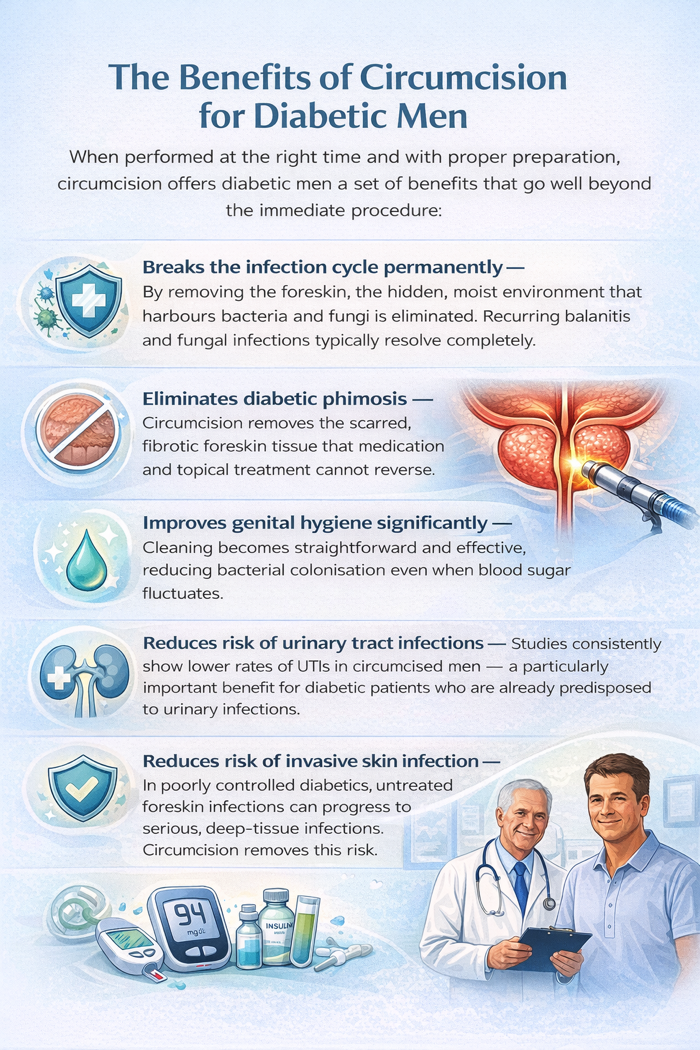
When performed at the right time and with proper preparation, circumcision offers diabetic men a set of benefits that go well beyond the immediate procedure:
- Breaks the infection cycle permanently — By removing the foreskin, the hidden, moist environment that harbours bacteria and fungi is eliminated. Recurring balanitis and fungal infections typically resolve completely.
- Eliminates diabetic phimosis — Circumcision removes the scarred, fibrotic foreskin tissue that medication and topical treatment cannot reverse.
- Improves genital hygiene significantly — Cleaning becomes straightforward and effective, reducing bacterial colonisation even when blood sugar fluctuates.
- Reduces risk of urinary tract infections — Studies consistently show lower rates of UTIs in circumcised men — a particularly important benefit for diabetic patients who are already predisposed to urinary infections.
- Reduces risk of invasive skin infection — In poorly controlled diabetics, untreated foreskin infections can progress to serious, deep-tissue infections. Circumcision removes this risk.
- Improves quality of life — Relief from chronic discomfort, pain during urination, and recurring medical visits makes a tangible difference to daily life.
Is Circumcision Safe for Diabetic Patients?
This is the question that most diabetic men — and their families — ask first. And it deserves a thorough, honest answer rather than a simple yes or no.
Circumcision is safe for diabetic patients — but it requires more careful preparation and management than routine circumcision in a non-diabetic individual. The primary concern is wound healing: elevated blood sugar impairs the body’s ability to heal surgical wounds effectively, increasing the risk of infection, wound breakdown, and prolonged recovery.
The key to safe outcomes lies in three areas:
1. Pre-Operative Blood Sugar Optimisation
Surgery is planned only when blood glucose is adequately controlled. Ideally, fasting blood glucose should be below 180 mg/dL and HbA1c within acceptable surgical thresholds. If glucose control is poor, surgery is deferred and diabetes management is intensified first — in coordination with the patient’s diabetologist or physician.
2. Surgical Technique and Wound Closure
An experienced urologist performing circumcision in a diabetic patient uses meticulous, tension-free wound closure with fine absorbable sutures — minimising tissue trauma and creating the optimal conditions for healing in tissue that may have reduced vascularity due to diabetic microvascular changes.
3. Post-Operative Care Protocol
A structured post-operative plan including antibiotic cover, antifungal medication where appropriate, specific wound care instructions, and more frequent follow-up visits ensures that healing progresses safely and any early signs of wound complications are identified and managed promptly.
What Does Recovery Look Like?
Recovery after circumcision in diabetic patients may be slightly longer than in non-diabetic individuals — but with the right preparation and follow-up, most patients achieve complete, complication-free healing. Here is what to expect:
- First week — Mild swelling, bruising, and discomfort. Prescribed pain relief manages any significant discomfort. Wound care instructions must be followed precisely.
- Week 2–3 — Swelling reduces progressively. Most men can return to light activities and desk work within 5–7 days. Blood sugar monitoring continues throughout this period.
- Week 3–4 — Absorbable sutures begin to dissolve. The wound edge continues to heal. Strenuous activities and sexual activity are avoided for at least 4–6 weeks.
- Complete healing — Typically achieved within 4–6 weeks in well-controlled diabetic patients, slightly longer if blood sugar remains elevated during recovery.
Choosing the Right Surgeon Matters
For diabetic patients, the choice of surgeon is not just a matter of preference — it is a clinical decision that directly impacts safety and outcome. A urologist with specific experience in managing circumcision in high-risk patients, who works in a hospital with integrated diabetic care support and modern surgical facilities, offers the best possible conditions for a safe procedure and smooth recovery.
Expert Care in Ahmedabad
Dr. Prarthan Joshi at Zydus Hospitals, Ahmedabad, has extensive experience in performing circumcision for diabetic patients — including complex cases involving severe phimosis, recurrent infection, and long-standing diabetes. His structured approach to pre-operative optimisation, surgical precision, and post-operative care ensures consistently safe and effective outcomes for every diabetic patient under his care.
If you are a diabetic man dealing with recurring foreskin infections, increasing tightness, or discomfort that keeps coming back — do not delay. For expert Circumcision Treatment in Ahmedabad, consult Dr. Prarthan Joshi today and get a clear, honest assessment of your options.