



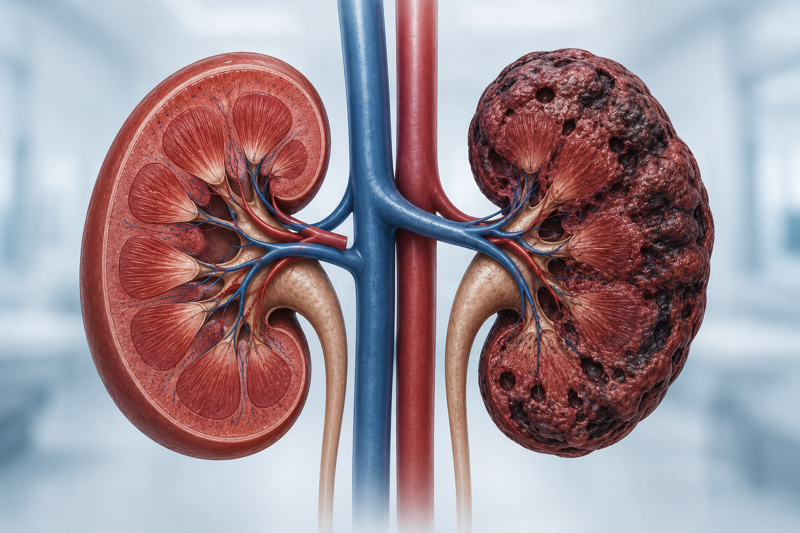
Your kidneys work silently — filtering over 180 litres of blood every day, regulating fluid balance, controlling blood pressure, producing hormones, and removing waste products through urine. They do all of this without any sensation, any warning light, or any obvious signal that something is going wrong. Which is precisely what makes chronic kidney disease (CKD) so dangerous: by the time most people notice symptoms, significant kidney function has already been lost.
CKD is not a rare condition. It affects an estimated 17% of adults in India — and the vast majority are unaware they have it. Understanding what CKD is, who is at risk, how it progresses, and what can be done to slow it down is knowledge that could quite literally save your kidneys — and your life.
What Is Chronic Kidney Disease?
Chronic kidney disease is the progressive, long-term loss of kidney function over months to years. Unlike acute kidney injury — which develops suddenly and is often reversible — CKD develops gradually and the damage, once established, cannot be fully reversed. However, its progression can be dramatically slowed with the right medical management — and in many cases, end-stage kidney failure can be prevented or significantly delayed.
CKD is classified into five stages based on the Glomerular Filtration Rate (GFR) — a measure of how efficiently the kidneys are filtering blood:
- Stage 1: GFR ≥90 — Kidney damage present but normal or near-normal function. Often detectable only through blood or urine tests.
- Stage 2: GFR 60-89 — Mildly reduced function. Usually no symptoms.
- Stage 3: GFR 30-59 — Moderately reduced function. Early symptoms may begin. Most patients are diagnosed here.
- Stage 4: GFR 15-29 — Severely reduced function. Symptoms more prominent. Preparation for renal replacement therapy begins.
- Stage 5: GFR <15 — End-stage renal disease (ESRD). Dialysis or kidney transplant required to sustain life.
What Causes CKD?
The two most common causes of CKD globally — and particularly in India — are diabetes and high blood pressure. Together, they account for the majority of CKD cases:
- Diabetic nephropathy: Chronic high blood sugar damages the tiny filtering vessels (glomeruli) of the kidneys over years. Every diabetic patient should have annual kidney function tests and urine albumin measurements.
- Hypertensive nephropathy: Sustained high blood pressure damages the renal vasculature, progressively impairing filtration capacity.
- Glomerulonephritis: Immune-mediated inflammation of the kidney’s filtering units — several subtypes exist, some responding well to immunosuppressive treatment.
- Polycystic kidney disease (PKD): A genetic condition in which cysts progressively replace normal kidney tissue. Family history is a critical clue.
- Recurrent kidney infections (chronic pyelonephritis): Repeated upper urinary tract infections can cause cumulative renal scarring.
- Obstructive nephropathy: Long-standing urinary obstruction — from kidney stones, enlarged prostate, or structural abnormalities — causes back-pressure damage to kidney tissue.
- Certain medications: Long-term use of NSAIDs (painkillers like ibuprofen, diclofenac), certain antibiotics, and contrast agents can damage the kidneys — particularly in those already at risk.
Recognising the Signs — The Silent Thief
CKD earns its reputation as the “silent disease” because early stages produce no symptoms at all. By Stage 3, some patients begin to notice:
- Fatigue and weakness — anaemia develops as failing kidneys produce less erythropoietin.
- Swelling (oedema) in the ankles, feet, or around the eyes — from fluid retention.
- Foamy or bubbly urine — indicating protein leakage (proteinuria).
- Changes in urination — more frequent at night, reduced output in advanced stages.
- High blood pressure that is difficult to control.
- Loss of appetite, nausea, and itching — classic uraemic symptoms appearing in advanced CKD.
- Shortness of breath — from fluid accumulation or anaemia.
The critical point is that waiting for symptoms before checking kidney function means missing the window for most effective intervention. Anyone with diabetes, hypertension, a family history of kidney disease, or recurrent kidney stones should have annual kidney function screening — even when they feel completely well.
How Is CKD Diagnosed?
- Serum creatinine and eGFR (estimated GFR) — the primary measure of kidney filtration capacity.
- Urine albumin-to-creatinine ratio (UACR) — detecting early protein leakage, the earliest sign of diabetic and hypertensive kidney damage.
- Urine analysis — checking for blood, protein, casts, and infection.
- Ultrasound of kidneys — assessing kidney size, cortical thickness, scarring, cysts, and obstruction.
- Additional tests as indicated — renal biopsy, immunological tests, genetic testing depending on the suspected cause.
Managing CKD: Slowing the Progression
CKD cannot currently be cured, but its progression can be substantially slowed with consistent, evidence-based management:
- Aggressive blood pressure control: Target <130/80 mmHg in CKD patients. ACE inhibitors or ARBs are first-line — they provide kidney-protective benefits beyond blood pressure lowering.
- Optimal diabetes management: HbA1c control reduces the rate of diabetic kidney disease progression significantly.
- SGLT2 inhibitors: A newer class of diabetes medications now proven to have powerful kidney-protective effects independent of glucose control — a major advance in CKD management.
- Dietary modifications: Controlled protein, potassium, phosphate, and salt intake as guided by the treating nephrologist or urologist based on CKD stage.
- Avoiding nephrotoxic medications: NSAIDs, certain antibiotics, and iodinated contrast agents should be used with extreme caution or avoided entirely.
- Treating anaemia and mineral bone disease: Erythropoietin-stimulating agents and phosphate binders as needed.
- Preparation for renal replacement therapy: At Stage 4, planning for dialysis access or transplant evaluation begins — so that when the time comes, the patient is prepared rather than rushed into an emergency.
The Role of Urology in CKD
Urological causes of CKD — including obstructive uropathy from kidney stones, enlarged prostate, or structural abnormalities — are particularly important because correcting the obstruction can halt or partially reverse progression. This is distinct from medical causes of CKD where damage is less reversible. Every CKD patient should have a urological assessment to exclude a correctable obstructive cause.
Dr. Prarthan Joshi at Zydus Hospitals, Ahmedabad, evaluates and manages urological causes of kidney disease — from obstructive stone disease and BPH-related kidney damage to post-transplant urological complications. For comprehensive Kidney Disease Treatment in Ahmedabad from a specialist who understands both the urological and systemic dimensions of renal health, consult Dr. Joshi today.