



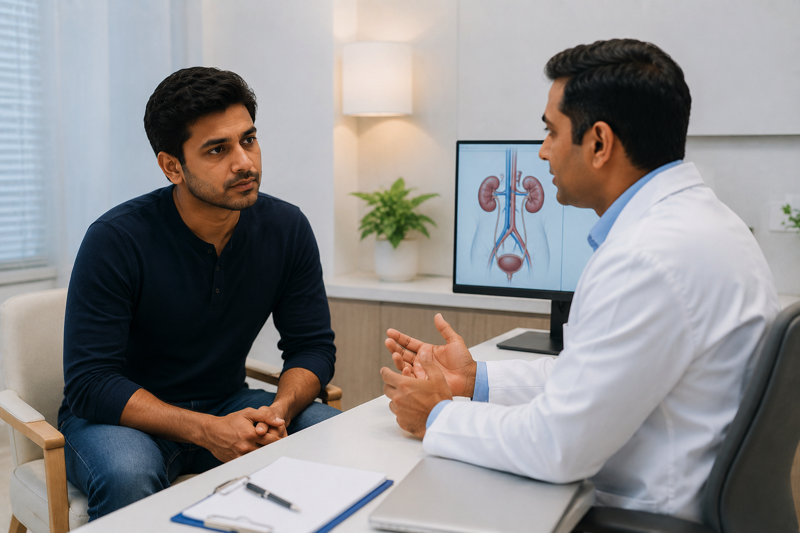
Testicular cancer carries a distinction that very few cancers share: it is one of the most curable solid tumours in medicine, with overall survival rates exceeding 95% when diagnosed and treated correctly. Yet it is also a cancer that strikes at a particularly vulnerable time — affecting men most commonly between the ages of 15 and 35 — and one that, because of its location and the social stigma around it, is frequently discovered later than it should be.
Every young man should know the basics of testicular cancer — not to live in fear, but to be empowered to act quickly if something changes. Because in testicular cancer, speed of diagnosis genuinely matters. And the first step toward diagnosis is simply paying attention.
What Is Testicular Cancer?
Testicular cancer originates in the testicles — the male reproductive organs that produce testosterone and sperm, located within the scrotum. The vast majority (approximately 95%) of testicular cancers are germ cell tumours — tumours arising from the sperm-producing cells. They are classified into two main types:
- Seminoma: A slower-growing germ cell tumour that typically remains confined to the testicle longer and is highly sensitive to radiation therapy. More common in men in their 30s and 40s.
- Non-seminoma: A group of faster-growing tumours including embryonal carcinoma, yolk sac tumour, choriocarcinoma, and teratoma. More common in men in their late teens and 20s. Often presents as a mixed tumour containing multiple subtypes.
Less common testicular tumours include Leydig cell tumours and Sertoli cell tumours — which are usually benign — and lymphoma of the testis, which is more common in older men.
Risk Factors
While testicular cancer can occur in any man, several factors increase the risk:
- Undescended testis (cryptorchidism): The single strongest risk factor. Men with a history of undescended testis have a 3-5 times higher lifetime risk of testicular cancer — even if the testis was surgically corrected in childhood.
- Family history: A father or brother with testicular cancer increases personal risk.
- Personal history: A man who has had testicular cancer in one testicle has an increased risk of developing it in the other.
- Age: Peak incidence is between 15 and 35 years, though it can occur at any age.
- Certain genetic conditions: Klinefelter syndrome is associated with a modestly increased risk.
Symptoms: What to Look For
Testicular cancer is most commonly first noticed as a painless lump or swelling in one testicle. This is why monthly testicular self-examination — ideally after a warm shower when scrotal skin is relaxed — is valuable for young men. Key symptoms include:
- A painless lump, swelling, or change in size or shape of a testicle.
- A feeling of heaviness in the scrotum.
- A dull ache in the lower abdomen, groin, or scrotum.
- A sudden collection of fluid in the scrotum (acute hydrocele in a young man always warrants investigation).
- Breast tenderness or growth (gynaecomastia) — from hormone-secreting tumours.
- Back pain, shortness of breath, or swollen lymph nodes in the neck — symptoms suggesting metastatic disease.
The absence of pain is what most commonly causes delay — men assume that a painless swelling cannot be serious. It is. Any new scrotal lump in a young man should be evaluated by a urologist within days, not weeks.
Diagnosis
- Scrotal ultrasound: The first-line investigation — highly sensitive for detecting testicular masses and characterising them as likely benign or malignant.
- Tumour markers: Alpha-fetoprotein (AFP), beta-human chorionic gonadotropin (beta-hCG), and lactate dehydrogenase (LDH) — elevated in many testicular germ cell tumours. Used for diagnosis, staging, monitoring treatment response, and detecting recurrence.
- CT scan of chest, abdomen, and pelvis: Staging investigation to detect lymph node or organ metastases.
- Radical orchidectomy: Surgical removal of the affected testicle via an inguinal (groin) incision — this is both the definitive diagnostic procedure (providing histopathological confirmation) and the primary treatment. A scrotal incision is specifically avoided to prevent altering lymphatic drainage patterns.
Treatment: Why the Outcomes Are So Good
The reason testicular cancer carries such excellent survival rates is a combination of factors: it is usually diagnosed while still localised or regionally spread, and it is exquisitely sensitive to platinum-based chemotherapy (cisplatin regimens). Treatment depends on histological type and stage:
- Stage I (confined to testicle): Radical orchidectomy alone, followed by surveillance, adjuvant chemotherapy, or radiotherapy (for seminoma) depending on risk stratification. Cure rates approach 99%.
- Stage II (regional lymph node spread): Chemotherapy (BEP protocol) or radiotherapy for seminoma. Cure rates 95%+.
- Stage III (distant metastases): BEP chemotherapy — even metastatic testicular cancer achieves cure in 70-80% of cases. This is extraordinary compared to almost any other metastatic solid tumour.
Fertility Considerations
Testicular cancer and its treatment can affect fertility. Sperm banking before chemotherapy or radiotherapy is strongly recommended for all young men who may wish to father children in the future. A single testicle is fully capable of normal testosterone production and fertility — orchidectomy alone does not cause infertility in most cases.
Dr. Prarthan Joshi at Zydus Hospitals, Ahmedabad, offers expert testicular cancer evaluation — from urgent scrotal ultrasound and tumour marker testing to radical orchidectomy and post-treatment surveillance. For specialised Testicular Cancer Treatment in Ahmedabad, do not delay a suspicious scrotal finding. Speed of evaluation is everything.