



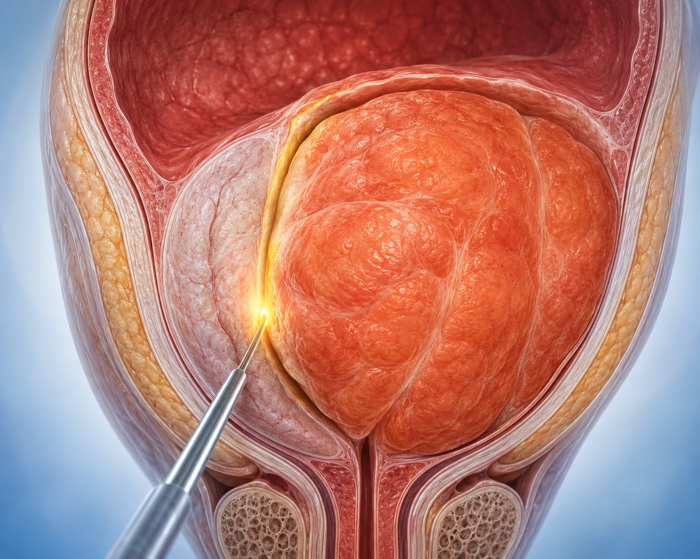
If you have a very large prostate and have been told that TURP may not be sufficient — or that you might need open surgery — I want you to know about a procedure that has changed that calculus significantly: HoLEP, or Holmium Laser Enucleation of the Prostate. It is technically demanding, it requires specific surgical expertise, and it is not the right approach for every patient. But for men with very large prostates, it offers something remarkable — a complete solution, through the urethra, with virtually no blood loss.
What Makes HoLEP Different
TURP works by resecting (cutting away) the obstructing prostate tissue piece by piece. HoLEP works differently: the Holmium laser separates the entire obstructing inner gland — the adenoma — from its surrounding capsule, in whole lobes, rather than in fragments. This is closer in principle to open prostatectomy — which historically was the treatment for very large prostates — but done endoscopically, through the urethra, without a single incision on the skin. The separated lobes are then morcellated (finely chopped) inside the bladder and irrigated out.
Because the laser seals blood vessels continuously throughout the procedure, blood loss is minimal — sometimes near zero. This makes HoLEP suitable for patients on anticoagulants, for older patients with cardiovascular conditions, and for men with prostates so large that other techniques would carry higher risk or require staging across multiple procedures.
What Patients Experience
The procedure is performed under spinal or general anaesthesia and takes between one and two hours depending on prostate size. A urinary catheter is placed at the end of surgery — and unlike conventional TURP, the catheter after HoLEP is often removed within twenty-four hours in most patients. Hospital stay is typically one to two days. Improvement in urine flow is frequently noticed as soon as the catheter comes out.
Some men experience temporary urgency or mild leakage in the first four to eight weeks after HoLEP as the bladder and sphincter adjust. This settles in the vast majority of cases. Pelvic floor exercises begun early after surgery help significantly with this transition.
Why the Retreatment Rates Matter
One of the statistics I share with patients considering HoLEP is this: the long-term retreatment rates — the proportion of men who need another procedure at ten or more years — are lower for HoLEP than for any other BPH surgical technique. The reason is straightforward: because the entire obstructing adenoma is removed, rather than a portion of it, there is simply less tissue left to regrow and cause symptoms again. For many men, HoLEP is effectively a once-in-a-lifetime procedure for their prostate. That is a meaningful thing to offer.
About the Author
Dr. Prarthan Joshi M.S., M.Ch. (Urology)
Urologist, Kidney Transplant Surgeon & Genito-Urinary Surgeon, Zydus Hospitals, Ahmedabad.
This article is shared for general patient education and awareness. It is not a substitute for a personal consultation. If any of the symptoms or concerns here apply to you, please speak with a qualified doctor.