



There is a version of frequent urination that most people know: the coffee you had at ten o’clock, the extra glass of water, the obvious cause. That is not what I am talking about here. I am talking about the person who is urinating ten, twelve, fifteen times a day. Who rushes to the bathroom with a sudden urgent need that is difficult to suppress. Whose bladder seems to be running on its own schedule, with little regard for how inconvenient that schedule is.
This kind of frequent urination is a medical condition, not a quirk of personality or an inevitable feature of getting older. It has causes that can be identified, and it has treatments that work. If this describes your life, I want to explain what might be happening and what we can do about it.
Why the Bladder Might Be Misfiring
The bladder has one job: store urine until a convenient moment, then release it when instructed. In people with urinary frequency, that process is disrupted. The most common reason is Overactive Bladder (OAB) — a condition where the bladder muscle contracts involuntarily and too often, sending urgent signals to void even when the bladder is far from full. This is a functional disorder — the plumbing is intact, but the signalling is misfiring.
In men, BPH is a very common driver of frequency. When the prostate obstructs the outlet, the bladder adapts by becoming overactive — contracting more aggressively and more often to overcome the resistance. Treating the prostate obstruction often dramatically improves the frequency as well.
Other causes include urinary tract infections (which cause a temporary but acute frequency), diabetes (which increases urine production through elevated blood sugar), bladder pain syndrome, and certain medications. Sometimes it is a combination of factors rather than a single cause — which is why a proper evaluation matters rather than guessing.
What I Ask Patients to Do Before Their Appointment
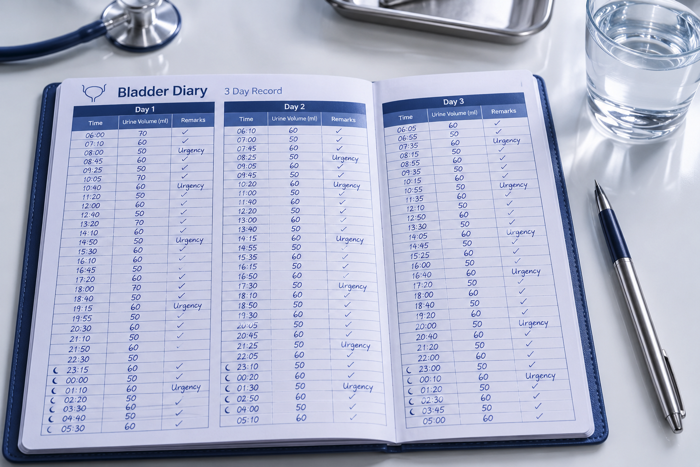
I often ask patients to keep a bladder diary for three days before we meet — a simple record of what they drink, when they urinate, and roughly how much. It sounds mundane, but the information it gives me is genuinely valuable. It tells me whether the problem is primarily an overactive bladder producing urgent small voids, or whether large volumes of urine are being produced at night, or whether fluid intake patterns are the main driver. That distinction shapes the entire treatment approach.
Treatment That Actually Works
Behavioural therapy — timed voiding, gradual bladder training, fluid management — is the first step and works better than most people expect. Medications that calm the overactive bladder muscle are effective in many patients. For those who do not respond adequately to medications, Botox injected into the bladder wall is a highly effective minimally invasive option that can provide months of significant relief from a single treatment session. And where an underlying cause like BPH is identified, treating that cause directly often resolves the frequency without additional specific treatment.
The bottom line is this: frequent urination is treatable. It does not have to define your day.
About the Author
Dr. Prarthan Joshi M.S., M.Ch. (Urology)
Urologist, Kidney Transplant Surgeon & Genito-Urinary Surgeon, Zydus Hospitals, Ahmedabad.
This article is shared for general patient education and awareness. It is not a substitute for a personal consultation. If any of the symptoms or concerns here apply to you, please speak with a qualified doctor.