



I have sat across from many patients — and their families — in the moment after a kidney cancer diagnosis is confirmed. That moment carries a particular weight. Even when the news is genuinely good — and often it is — the word “cancer” lands heavily, and it can be hard to take in anything else that is said immediately after. I understand that. And it is one of the reasons I want to write this: so that when you are ready to understand more, the information is here, written clearly and without jargon.
The first thing I want to say is this: kidney cancer, when detected at an early stage, has an excellent prognosis. The majority of kidney cancers we treat today are found before they have spread — often discovered incidentally on an ultrasound or CT scan done for an entirely unrelated reason. And with the minimally invasive surgical techniques we now have available, the treatment itself is far less daunting than patients often fear.
What Kidney Cancer Surgery Actually Involves Today
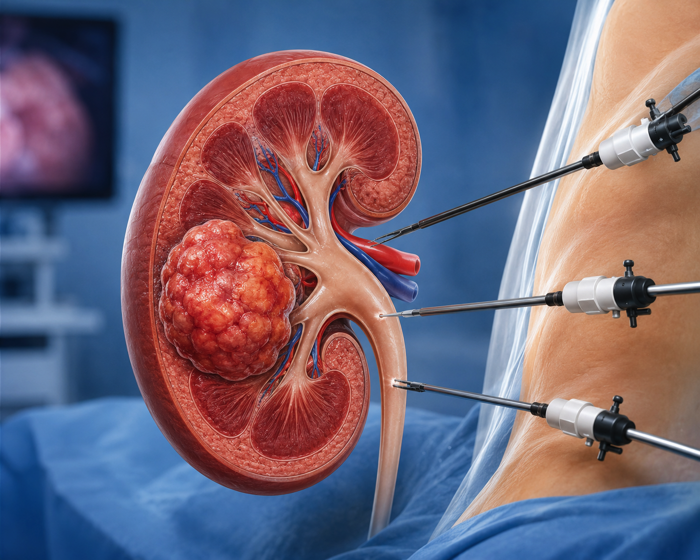
The goal of surgery for kidney cancer is simple to state: remove the cancer completely while preserving as much healthy kidney tissue as possible. How we achieve that depends on the size and location of the tumour, and on the patient’s overall kidney function — but in most cases today, we can do this through small keyhole incisions rather than a large open wound.
For tumours under seven centimetres — which is the majority of cases we see — the preferred approach is what we call a partial nephrectomy: removing the tumour and a margin of healthy tissue around it, while leaving the rest of the kidney intact. This protects your long-term kidney function, which matters greatly for your overall health in the decades ahead. For larger tumours or those in more complex positions, removing the entire kidney (radical nephrectomy) may be the safer oncological choice, and most people live completely normally with a single healthy kidney.
Both procedures are now routinely performed laparoscopically — through three or four small incisions, with a camera guiding the surgery. Most patients go home within two to three days. Recovery is measured in weeks, not months.
The Questions That Come Up Most Often
I found this on a routine scan and feel completely well. Do I really need surgery?
In most cases of localised kidney cancer, yes — surgery offers the best chance of cure and is far preferable to watching and waiting while the tumour has time to grow. That said, for very small tumours in older patients with significant other health conditions, active surveillance with regular imaging is sometimes a reasonable approach. I will always explain your specific situation clearly and give you my honest clinical recommendation.
Will I need chemotherapy or radiation after surgery?
Unlike many other cancers, kidney cancer does not respond well to conventional chemotherapy or radiation. Surgery is the primary and most effective treatment for localised disease. For cancers that have spread beyond the kidney, modern targeted therapy and immunotherapy medications have transformed what is possible — but for the majority of patients, surgery alone is curative.
How will I know if the cancer has come back?
After surgery, I follow a structured surveillance schedule with regular imaging and blood tests. The frequency depends on the stage and grade of your tumour. The purpose is simple: to detect any change at the earliest possible moment, when the options for further treatment are widest. You will never be left wondering — I will always tell you clearly what your results show and what, if anything, they mean for your ongoing care.
About the Author
Dr. Prarthan Joshi M.S., M.Ch. (Urology)
Urologist, Kidney Transplant Surgeon & Genito-Urinary Surgeon, Zydus Hospitals, Ahmedabad.
This article is shared for general patient education and awareness. It is not a substitute for a personal consultation. If any of the symptoms or concerns here apply to you, please speak with a qualified doctor.