



I am always a little struck by how long men wait before coming to see me about a weak urine stream. By the time they sit across from me, many have been straining to urinate for two, three, sometimes five years. They have adjusted. They allow more time in the bathroom, they avoid certain social situations, they chalk it up to age. What I try to do in that first conversation is gently dismantle the assumption that this is simply how things are now.
A weak urine stream is a symptom. It has causes — specific, identifiable causes — and when the cause is found and treated, the improvement can be dramatic. Let me explain what I look for and what treatment can offer.
The Causes I See Most Often
In men over fifty, the most common cause by far is an enlarged prostate — BPH. The prostate gradually compresses the urethra, reducing the force and speed of urine flow over time. The change is so gradual that many men do not notice it until it is quite advanced.
The second most common cause is a urethral stricture — a narrowing of the urethra caused by scar tissue. This can follow a previous infection (particularly certain sexually transmitted infections), an injury to the pelvic or genital area, prior catheterisation, or previous endoscopic procedures. Strictures produce a distinctive pattern — often a thin, forked, or spray stream that has progressively worsened over months or years.
Less commonly, weak flow results from the bladder muscle itself losing strength — a condition called detrusor underactivity. Here, the problem is not that something is blocking the outlet; it is that the bladder simply cannot generate enough pressure to push urine out efficiently. This can occur in men with longstanding diabetes, neurological conditions, or those who have had pelvic surgery.
How I Find the Cause
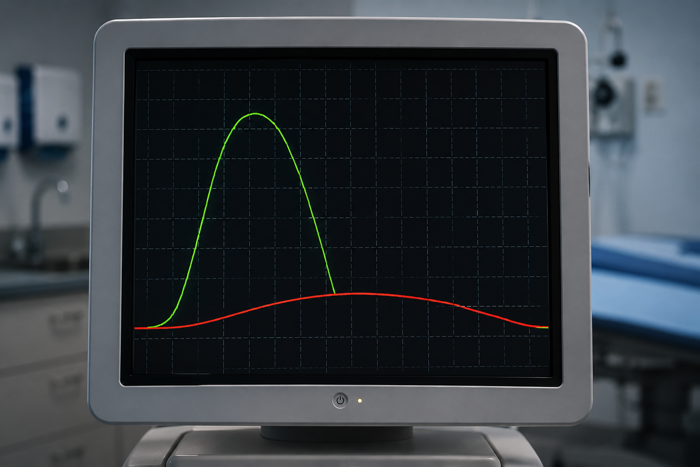
The key investigation is a simple, non-invasive test called uroflowmetry — you urinate into a special device that measures your flow rate, flow pattern, and total volume. Combined with an ultrasound to check how much urine remains in your bladder after urination, this gives me a clear objective picture of what is happening. From there, additional tests — a PSA blood test, prostate ultrasound, or in some cases a flexible cystoscopy — help pinpoint the cause.
What Treatment Looks Like
If the cause is BPH, I start with the simplest effective option — medication — and move to surgical treatment (Bipolar TURP or laser surgery) when that is the appropriate next step. If the cause is a urethral stricture, treatment ranges from dilatation for short strictures to reconstructive surgery (urethroplasty) for longer or recurrent ones. If bladder muscle weakness is the problem, management involves different strategies, including clean intermittent self-catheterisation to protect the bladder and kidneys from the consequences of incomplete emptying.
The point is: weak flow has a cause, and that cause has a treatment. The first step is a conversation and an assessment. I encourage you not to leave it any longer than you already have.
About the Author
Dr. Prarthan Joshi M.S., M.Ch. (Urology)
Urologist, Kidney Transplant Surgeon & Genito-Urinary Surgeon, Zydus Hospitals, Ahmedabad.
This article is shared for general patient education and awareness. It is not a substitute for a personal consultation. If any of the symptoms or concerns here apply to you, please speak with a qualified doctor.