



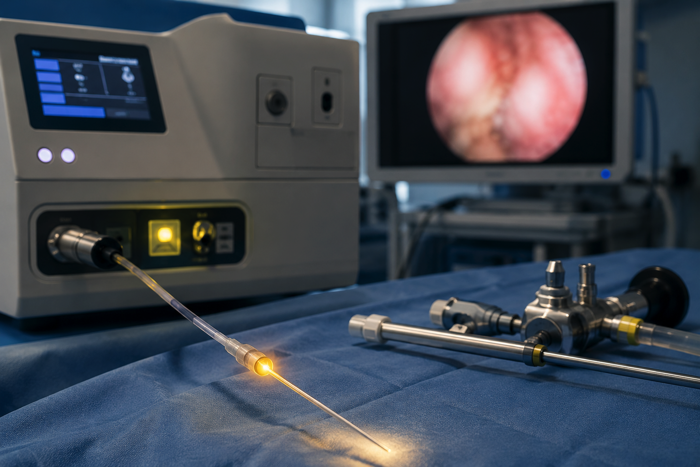
Not every man who needs prostate surgery is the same patient. Some have relatively modest prostate enlargement and are otherwise healthy. Others have very large glands, or they take blood-thinning medication for a heart condition, or they are older with other medical complexities that make certain surgical approaches riskier than others. Laser prostate surgery exists, in large part, because of those patients — and it has genuinely changed what is possible for them.
Let me explain what laser surgery for the prostate is, which patients benefit most from it, and why I sometimes recommend it over conventional TURP — and sometimes do not, because the right choice is always about the individual in front of me, not a blanket preference for one technique over another.
What Laser Prostate Surgery Is
Laser prostate surgery uses a high-powered laser fibre, passed through the urethra, to either vaporise the obstructing prostate tissue (as in GreenLight laser surgery) or to separate and remove it whole (as in HoLEP, which I will describe in a separate article). Like TURP, no skin incisions are made at any point — the entire procedure is endoscopic.
The laser’s most important property is this: it seals blood vessels as it works. This makes the procedure essentially bloodless in most cases. For men who are on warfarin, newer anticoagulants, or aspirin for cardiac reasons — men who cannot safely stop blood thinners long enough for conventional surgery — this is a genuine and important advantage. GreenLight laser in particular can often be performed without stopping blood-thinning medication at all.
When I Recommend Laser Surgery
My recommendation depends on several factors. For a man with a prostate in the moderate size range who is otherwise healthy, Bipolar TURP remains an excellent and very slightly more established choice. For a man on anticoagulants who cannot stop them, GreenLight laser is often the better path. For a man with a very large prostate — over eighty millilitres or more — HoLEP offers a complete solution that TURP alone may not achieve in a single procedure. I discuss all of this openly at your consultation, and I am always happy to explain the reasoning behind my recommendation.
What Patients Often Ask
Is laser surgery more painful than conventional prostate surgery?
No. Both are performed under spinal or general anaesthesia — you are completely comfortable throughout. Recovery is broadly similar, though GreenLight laser sometimes allows for a slightly shorter catheter time and, in some cases, day-case discharge. The choice between techniques is driven by clinical factors, not by pain or comfort differences.
Are the results as durable as TURP?
Yes, and in some cases — particularly with HoLEP — the long-term retreatment rates are actually lower. Laser surgery has a very solid evidence base, and the outcomes are genuinely comparable to or better than conventional TURP in the right patient. I would not offer it if I were not confident in the results it delivers.
About the Author
Dr. Prarthan Joshi M.S., M.Ch. (Urology)
Urologist, Kidney Transplant Surgeon & Genito-Urinary Surgeon, Zydus Hospitals, Ahmedabad.
This article is shared for general patient education and awareness. It is not a substitute for a personal consultation. If any of the symptoms or concerns here apply to you, please speak with a qualified doctor.