


The idea of breaking a kidney stone without making a single incision — without anaesthesia, without a hospital stay, and without significant recovery time — sounds almost too good to be true. Yet that is precisely what Extracorporeal Shock Wave Lithotripsy (ESWL) offers. Since its introduction in the early 1980s, ESWL has transformed the management of kidney and ureteric stones, making non-invasive stone fragmentation a routine, outpatient procedure for hundreds of thousands of patients worldwide every year.
Understanding what ESWL is, how it works, which stones it is best suited for, and what to expect from the procedure and recovery helps patients make informed decisions about their stone treatment — and sets realistic expectations about outcomes.
What Is ESWL?
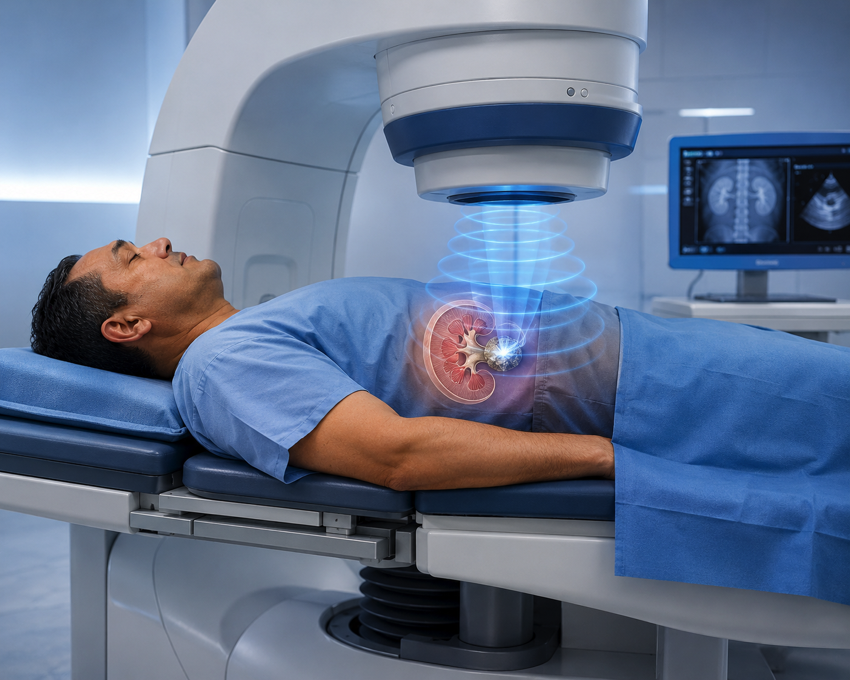
Extracorporeal Shock Wave Lithotripsy is a non-invasive procedure that uses high-energy acoustic shock waves, generated outside the body (hence extracorporeal), to fragment kidney stones into smaller pieces that can then pass naturally through the urine over the following days to weeks. The procedure requires no incisions, no endoscopes, no anaesthesia in most cases, and no hospital admission — it is performed as a day-care procedure, after which most patients return home within a few hours.
The shock waves are generated by an electrohydraulic, electromagnetic, or piezoelectric source within the lithotripter machine, focused onto the stone using real-time X-ray or ultrasound imaging guidance. Thousands of shock waves are delivered during a single session — each one contributing incrementally to the fracturing of the stone’s crystalline structure until it breaks apart into fragments small enough to pass through the urinary tract.
Which Stones Are Best Suited to ESWL?
ESWL is not appropriate for every kidney stone — and patient selection is the single most important factor determining treatment success. ESWL works best for:
- Stones up to 2cm in diameter located in the kidney — particularly in the renal pelvis or upper and mid-pole calyces.
- Stones with lower density on CT scan (Hounsfield Units below 1000) — softer stones fragment more readily with shock waves.
- Single stones rather than multiple or staghorn calculi.
- Calcium oxalate dihydrate and uric acid stones — both fragment well with ESWL.
- Patients with no significant anatomical obstruction downstream — fragments must be able to pass through the ureter.
ESWL is less effective — or should not be used — in the following situations:
- Stones larger than 2cm — fragmentation may occur but clearance of all fragments is poor, often requiring follow-up procedures.
- Very hard stones (calcium oxalate monohydrate, cystine, brushite) — resistant to shock wave fragmentation.
- Lower pole kidney stones — gravity works against fragment clearance from the lower pole calyces.
- Pregnancy — absolutely contraindicated.
- Uncorrected bleeding disorders or patients on anticoagulants.
- Anatomical obstruction downstream — stone fragments cannot pass if the ureter is obstructed.
- Obesity — excess tissue between the skin and the stone attenuates shock wave energy delivery.
- Active kidney infection — must be treated before ESWL.
The ESWL Procedure: What to Expect
ESWL is typically performed as a day-care procedure without general anaesthesia, though intravenous analgesia or mild sedation is often provided for patient comfort. Here is what the session involves:
- The patient lies on a padded table over the lithotripter water cushion or sits in a water bath depending on the machine type.
- The stone is localised using real-time fluoroscopy (X-ray) or ultrasound imaging — the machine’s focal point is precisely aligned with the stone.
- Shock waves are delivered at a controlled rate — typically 60-120 per minute — over 30-60 minutes. A single session usually delivers 2,000-3,500 shock waves.
- The patient experiences a tapping or mild thudding sensation over the flank during the procedure — not usually described as painful with appropriate analgesia.
- After the session, the patient rests briefly in the recovery area and is discharged home with instructions to stay well hydrated to help flush stone fragments.
After ESWL: What Happens Next
Stone fragmentation occurs during the procedure — but fragment passage happens over the following days to weeks. Patients should expect:
- Sand, grit, or small stone fragments in the urine — a sign that the treatment is working. Straining urine through a filter paper to capture fragments for analysis is often recommended.
- Renal colic episodes — as fragments pass through the ureter, they can cause pain similar to the original stone. Prescribed analgesia manages this effectively for most patients.
- Blood in urine — mild haematuria is expected and normal for a few days after ESWL.
- Bruising over the treated flank — from the shock wave energy passing through skin and muscle tissue.
- Follow-up imaging at 4-6 weeks to assess stone clearance — X-ray or ultrasound confirms whether the stone has fragmented and whether fragments have passed.
How Many Sessions Are Needed?
Many patients achieve adequate stone fragmentation in a single ESWL session. However, particularly for larger or denser stones, two or even three sessions spaced at least 2 weeks apart may be needed to achieve satisfactory fragmentation. If stone clearance is inadequate after an appropriate number of sessions, escalation to ureteroscopic laser treatment or PCNL may be recommended.
ESWL vs Ureteroscopy: How the Choice Is Made
For stones in the 1-2cm kidney range, both ESWL and flexible ureteroscopy (RIRS) are reasonable options — and the choice depends on stone density, location, patient preference, and available expertise. ESWL requires no anaesthesia and is completely non-invasive but may need multiple sessions and has lower stone-free rates for dense or lower-pole stones. Ureteroscopy is a single session under anaesthesia with higher stone-free rates but involves passing an instrument through the urinary tract. An experienced urologist discusses both options transparently and helps each patient choose based on their specific stone characteristics and priorities.
Expert Stone Care in Ahmedabad
Dr. Prarthan Joshi at Zydus Hospitals, Ahmedabad, offers the complete range of kidney stone treatments in Ahmedabad — from non-invasive ESWL and ureteroscopic laser lithotripsy to PCNL for complex stone burdens — with precise patient selection to ensure every patient receives the treatment most likely to achieve a stone-free outcome safely and efficiently. For expert Lithotripsy Treatment in Ahmedabad, consult Dr. Joshi today for a clear, personalised stone management plan.