



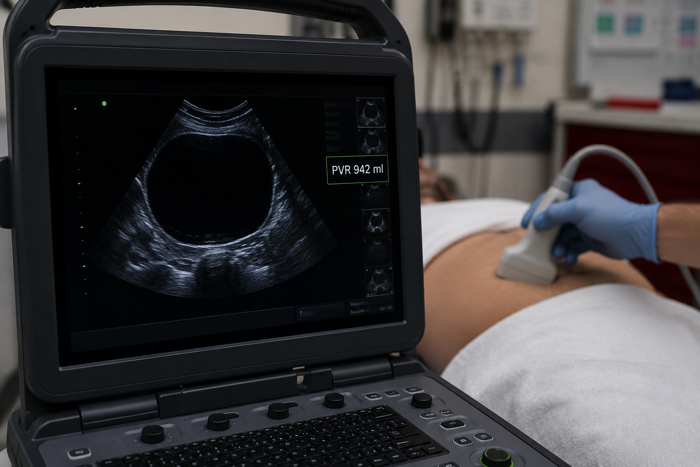
If you have ever experienced the acute form of urinary retention — the sudden, complete inability to urinate despite desperately needing to — you will know that it is one of the most distressing physical experiences imaginable. The bladder fills, the urge becomes overwhelming, and nothing happens. It is a urological emergency, and it needs to be treated immediately.
But there is also a quieter, slower version of this condition — chronic urinary retention — where the bladder never fully empties but the person can still pass some urine. This form is often missed for a long time, because it may cause relatively little discomfort even while the bladder is holding hundreds of millilitres of residual urine. Both forms are serious, and both deserve proper medical attention.
What Causes Urinary Retention
In men, the most common cause by far is an enlarged prostate — the prostate gradually obstructs the urethra until, at some point, the system simply cannot cope. For many men, acute retention is the event that finally brings them to seek help, and it is often the culmination of a long period of worsening symptoms that were manageable until suddenly they were not.
Urethral stricture — scar tissue narrowing the urethra — is another important cause, particularly in younger men. Neurological conditions that affect bladder nerve supply, including advanced diabetes and spinal cord problems, can cause the bladder muscle to lose its ability to contract adequately. Certain medications — including some antihistamines, decongestants, and psychiatric medications — can precipitate retention in men with pre-existing prostate enlargement. And sometimes retention follows surgery under anaesthesia, particularly abdominal or pelvic procedures.
Immediate and Long-Term Treatment
In acute retention, the immediate priority is decompressing the bladder — passing a catheter to drain the urine and relieve the discomfort. This is done in an emergency setting and provides almost immediate relief. The catheter then stays in place while I assess what has caused the retention and plan the appropriate definitive treatment.
The catheter is a temporary solution, not a long-term answer. It manages the immediate situation while we address the underlying cause — whether that means surgical treatment for BPH, repair of a urethral stricture, or another approach specific to the cause in your case. My goal for every patient is to restore normal voiding and eliminate the need for a catheter.
What Chronic Retention Does to the Bladder and Kidneys
This is the part that concerns me most when I see patients who have been living with large residual urine volumes for a long time without knowing it. The bladder muscle, repeatedly stretched by the retained urine, eventually loses its ability to contract properly — a kind of wear-and-tear that becomes harder to reverse the longer it continues. And in severe cases, the back-pressure from a consistently overfull bladder can affect kidney function. These are the consequences of leaving retention untreated that I most want people to understand and to avoid. An ultrasound to check your post-void residual volume is a simple, painless test that tells us a great deal. If you have any reason to suspect your bladder is not emptying fully, please come and have it checked.
About the Author
Dr. Prarthan Joshi M.S., M.Ch. (Urology)
Urologist, Kidney Transplant Surgeon & Genito-Urinary Surgeon, Zydus Hospitals, Ahmedabad.
This article is shared for general patient education and awareness. It is not a substitute for a personal consultation. If any of the symptoms or concerns here apply to you, please speak with a qualified doctor.