



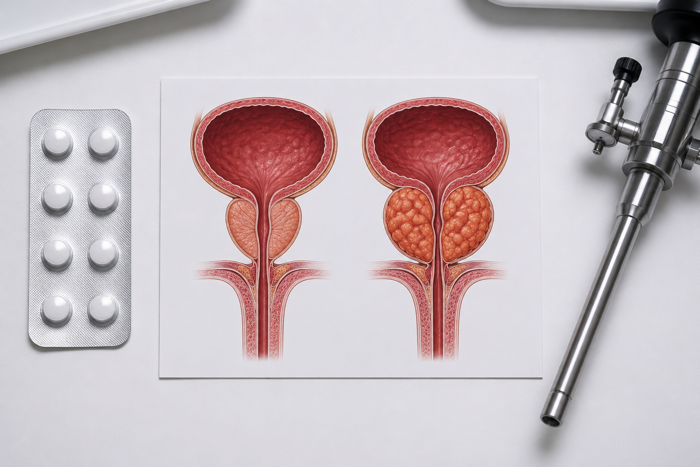
There is a particular kind of stoicism that many men bring to urological symptoms. A slow stream, difficulty starting, frequent night-time trips to the bathroom — these things accumulate quietly over years, and at some point a man realises that what he experiences today is just his normal now. He has adapted without noticing he was doing it.
I see this in my clinic regularly, and I want to say something directly: an enlarged prostate is a medical condition, not an inevitability of aging that must simply be endured. It has treatments — effective ones — and the quality of life improvement that comes from addressing it properly is often transformative. Men who finally get treatment regularly tell me they had forgotten what it felt like to sleep through the night or empty their bladder completely. I want that for every patient.
Understanding What Is Happening in Your Body
The prostate gland sits directly below the bladder and wraps around the urethra — the tube through which urine exits the body. As the prostate grows, it gradually tightens around that tube, increasing resistance to urine flow. The bladder, which has to push harder to overcome that resistance, eventually becomes thickened and overactive. This is why an enlarged prostate can cause not just a weak stream but also urgency, frequency, and night-time waking — it affects the entire lower urinary system over time.
The important thing to understand is that this is a progressive condition. Without treatment, symptoms tend to worsen gradually, and complications — including complete inability to urinate, bladder stones, or kidney involvement — can develop. The earlier it is addressed, the more straightforward the treatment.
What Treatment Actually Involves
Treatment for an enlarged prostate exists on a spectrum, and I always start at the least invasive end that is clinically appropriate. For mild symptoms, lifestyle adjustments and monitoring may be all that is needed initially. For moderate symptoms, medications work well for many men — alpha-blockers relax the prostate muscle and improve flow relatively quickly, while a second class of medication gradually reduces the size of the gland over six to twelve months. Many men do very well on medications for years.
When medications are no longer sufficient, or when complications have developed, surgery becomes the right path — and modern prostate surgery is genuinely minimally invasive. The most common procedure, Bipolar TURP, removes the obstructing tissue through the urethra with no skin incisions. Most patients experience dramatic improvement in their urine flow within weeks.
A Question I Am Often Asked
My father had a very difficult time with prostate surgery years ago. Is it still like that?
Prostate surgery has changed enormously over the past two decades. The procedures we use today — advanced bipolar resection and laser techniques — are far safer, with significantly less blood loss, shorter hospital stays, and faster recovery than the approaches used in earlier generations. Many of the stories that men’s fathers tell about prostate operations simply do not apply to what I do today. I encourage you to judge the current options on their own merits, not on what someone experienced twenty or thirty years ago.
About the Author
Dr. Prarthan Joshi M.S., M.Ch. (Urology)
Urologist, Kidney Transplant Surgeon & Genito-Urinary Surgeon, Zydus Hospitals, Ahmedabad.
This article is shared for general patient education and awareness. It is not a substitute for a personal consultation. If any of the symptoms or concerns here apply to you, please speak with a qualified doctor.